



Pomacentrus philippinus Evermann & Seale, 1907
Philippine damsel
添加你自己的观测位置在 Fish Watcher
| Native range | All suitable habitat | Point map | Year 2050 |

|
| This map was computer-generated and has not yet been reviewed. |
| Pomacentrus philippinus AquaMaps Data sources: GBIF OBIS |
分类 / 名称 俗名 | 同种异名 | Catalog of Fishes(属, 种) | ITIS | CoL | WoRMS | Cloffa
Teleostei > Ovalentaria/misc (Various families in series Ovalentaria) 鱸形目 (Various families in series Ovalentaria) > Pomacentridae (Damselfishes) 雀鯛科(Damselfishes) (Damselfishes) > Pomacentrinae
Etymology: Pomacentrus: Greek, poma, -atos = cover, operculum + Greek, kentron = sting (Ref. 45335).
More on authors: Evermann & Seale.
Etymology: Pomacentrus: Greek, poma, -atos = cover, operculum + Greek, kentron = sting (Ref. 45335).
More on authors: Evermann & Seale.
Taxonomic Remarks
There are several species involved in the Pomacentrus philippinus complex that information (and references) for this species (and other species involved) will be checked, verified and updated accordingly.
环境:氛围 / 气候带 / 深度上下限 / 分布范围 生态学
海洋 礁区鱼类; 非迁移的; 深度上下限 1 - 20 m (Ref. 7247). 热带; 30°N - 23°S
分布 领土 | FAO区域 | 生态系 | 标本纪录 | 分布图 | 简介 | Faunafri
Indo-West Pacific: Western Australia to eastern Indonesia; north to the Ryukyus; including Taiwan, the Philippines, Malaysia, Brunei and East Timor.
印度-西太平洋: 马尔地夫到罗雷浅滩,新加勒多尼亚与斐济, 北至琉球群岛。 最近从东加记录。 (参考文献 53797)
印度-西太平洋: 马尔地夫到罗雷浅滩,新加勒多尼亚与斐济, 北至琉球群岛。 最近从东加记录。 (参考文献 53797)
大小 / 重量 / 年龄
简单描述 检索表 | 型态特徵 | 形态测量图
背棘 (总数) : 13; 背的软条 (总数) : 13 - 15; 臀棘: 2; 臀鳍软条: 13 - 15; 脊椎骨: 26. This species is distinguished by the following characters: D XIII,13-15 (usually 14); A II,13-15 (usually 14); pectoral rays 16-18 (rarely 16); tubed lateral-line scales 16-19 (usually 17-18); total gill rakers on first arch 21-24 (usually 22-23); body depth 1.9-2.2 (mean 2.1) in SL; preorbital
usually with patch of scales, occasionally naked or with just a few isolated scales; suborbital
with single row of scales, occasionally restricted to posterior part, continuing around posterior
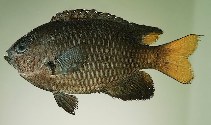
margin of the eye. Colouration: in life, usually charcoal to greyish with broad black scale margins on side of body, forming a network, sometimes a slight to strong yellow hue on caudal peduncle and lower sides; dorsal and anal fins are charcoal or blackish with posterior margin broadly orange (sometimes greatly reduced on anal fin); caudal fin is orange; pectoral fins with a black spot covering base, invading axil of fin; body side of pectoral-fin axil is distinctly orange; occasionally overall blackish to dark brown, including median fins except sometimes slightly orange on posteriormost portion of caudal fin; juveniles (< about 3.0 cm SL) mainly bluish grey with caudal fin, caudal peduncle, and adjacent portions of dorsal and anal fins bright yellow; Rowley Shoals, Western Australia population have very dark overall with orange portions of dorsal and caudal fins replaced with bright yellow and usually with entirely black anal fin (Ref. 131255).
Body shape (shape guide): fusiform / normal; Cross section: compressed.
稚鱼在身体上有黄色的垂直鳍与带紫色的外貌。
Body shape (shape guide): fusiform / normal; Cross section: compressed.
稚鱼在身体上有黄色的垂直鳍与带紫色的外貌。
Adults occur in lagoons, steep-sided channels, and seaward reefs from 2 to over 12 m (Ref. 1602). Usually found in groups off the sides of vertical drop-offs and overhanging ledges (Ref. 1602). Oviparous, distinct pairing during breeding (Ref. 205). Eggs are demersal and adhere to the substrate (Ref. 205). Males guard and aerate the eggs (Ref. 205). Diurnal species (Ref. 54980; 113699). Maximum depth reported taken from Ref. 128797.
出现于泻湖,边缘有大落差的峡道与超过 12 的临海礁石从 2 到公尺。 (参考文献 1602) 通常成群发现外海的垂直海峭壁与上悬的岩架侧边。 (参考文献 1602)
出现于泻湖,边缘有大落差的峡道与超过 12 的临海礁石从 2 到公尺。 (参考文献 1602) 通常成群发现外海的垂直海峭壁与上悬的岩架侧边。 (参考文献 1602)
生命周期和交配行为 成熟度 | 繁殖 | 产卵场 | 卵 | 孕卵数 | 仔鱼
Oviparous, distinct pairing during breeding (Ref. 205). Eggs are demersal and adhere to the substrate (Ref. 205). Males guard and aerate the eggs (Ref. 205).印度-西太平洋: 马尔地夫到罗雷浅滩,新加勒多尼亚与斐济, 北至琉球群岛。 最近从东加记录。 (参考文献 53797)
主要参考文献
上传您的参考资料 | 参考文献 | 合作者 : Allen, Gerald R. | 合作者
Allen, G.R., M.V. Erdmann and P.D. Pertiwi, 2017. Descriptions of four new species of damselfishes (Pomacentridae) in the Pomacentrus philippinus complex from the tropical western Pacific Ocean. J. Ocean Sci. Found. 25:47-76. (Ref. 114927)
CITES
Not Evaluated
对人类的威胁
无害处的
人类利用
渔业: 商业性; 水族馆: 商业性
FAO - Publication: search | FishSource |
更多信息
工具
特别资料
下载 XML
网络资源
AFORO (otoliths) | Aquatic Commons | BHL | Cloffa | Websites from users | 核实 FishWatcher | CISTI | Catalog of Fishes: 属, 种 | DiscoverLife | ECOTOX | FAO - Publication: search | Faunafri | Fishipedia | Fishtrace | GloBI | Google Books | Google Scholar | Google | IGFA World Record | 国家资料库 | OneZoom | Open Tree of Life | Otolith Atlas of Taiwan Fishes | PubMed | Reef Life Survey | Socotra Atlas | TreeBase | 树状分类阶层 | Wikipedia: 转至, 搜寻 | World Records Freshwater Fishing | Zoobank | 动物学的记录
基于模型的估算
首选温度 (参考文献 123201): 25.3 - 29.3, mean 28.4 °C (based on 2636 cells).
系统发育多样性指数 (参考文献 82804): PD50 = 0.5000 [Uniqueness, from 0.5 = low to 2.0 = high].
Bayesian length-weight: a=0.01778 (0.01002 - 0.03154), b=2.98 (2.82 - 3.14), in cm total length, based on LWR estimates for this species & (Sub)family-body (Ref. 93245).
营养阶层 (参考文献 69278): 2.7 ±0.29 se; based on food items.
回复力 (参考文献 120179): 高度, 族群倍增时间少于 15个月 (Preliminary K or Fecundity.).
营养素 (Ref. 124155): Calcium = 126 [70, 212] mg/100g; Iron = 0.834 [0.517, 1.318] mg/100g; Protein = 18.6 [17.6, 19.6] %; Omega3 = 0.138 [0.086, 0.220] g/100g; Selenium = 18.8 [10.9, 33.9] μg/100g; VitaminA = 144 [49, 433] μg/100g; Zinc = 2.2 [1.5, 3.0] mg/100g (wet weight);