Élasmobranches (requins et raies) (sharks and rays) >
Carcharhiniformes (Ground sharks) >
Pentanchidae (Deepwater catsharks)
Etymology: Asymbolus: Etymology not explained, possibly a-, Latin privative, i.e., without; sym-, from syn (Gr.), together or joined; bolus (L.), lump or morsel, proposed as a subgenus of Scyliorhinus (Scyliorhinidae) distinguished in part by labial fold of upper lip not hanging over lower-jaw symphysis of A. analis and A. vincenti (See ETYFish); submaculatus: sub (L.), under; maculatus (L.), spotted, referring to spots on undersurface in slightly more of half of the types (See ETYFish).
More on authors: Compagno, Stevens & Last.
Environment: milieu / climate zone / profondeur / distribution range
Écologie
marin pelagic-oceanic; profondeur 30 - 200 m (Ref. 36712). Temperate
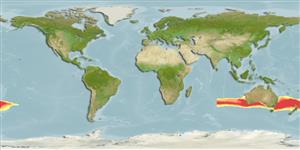
Southwest Pacific: New South Wales, Australia. Eastern Indian Ocean: Western Australia.
Taille / Poids / Âge
Maturité: Lm ? range ? - ? cm
Max length : 41.4 cm TL mâle / non sexé; (Ref. 36712); 43.8 cm TL (female)
Description synthétique
Clés d'identification | Morphologie | Morphométrie
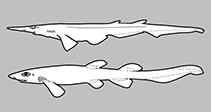
Body relatively robust; color pattern ornate and with multi-colored blotches overlaid with black spots. Caudal fin short; dorsal fins larger and more rounded. Tricuspidate teeth.
Body shape (shape guide): elongated.
Life cycle and mating behavior
Maturité | Reproduction | Frai | Œufs | Fécondité | Larves
Oviparous, paired eggs are laid. Embryos feed solely on yolk (Ref. 50449).
Compagno, L.J.V., J.D. Stevens and P.R. Last, 1999. Australian spotted catsharks of the genus Asymbolus (Carcharhiniformes: Scyliorhinidae). Part 1: Descriptions of three new species from western Australia. p. 2-18. In P.R. Last (ed.). Australian catsharks of the genus Asymbolus (Carcharhiniformes: Scyliorhinidae). (Ref. 36712)
Statut dans la liste rouge de l'IUCN (Ref. 130435: Version 2025-1)
Menace pour l'homme
Harmless
Utilisations par l'homme
Outils
Articles particuliers
Télécharger en XML
Sources Internet
Estimates based on models
Preferred temperature (Réf.
123201): 15.3 - 19.9, mean 16.7 °C (based on 42 cells).
Phylogenetic diversity index (Réf.
82804): PD
50 = 0.5020 [Uniqueness, from 0.5 = low to 2.0 = high].
Bayesian length-weight: a=0.00355 (0.00175 - 0.00721), b=3.08 (2.90 - 3.26), in cm total length, based on LWR estimates for this (Sub)family-body shape (Ref.
93245).
Niveau trophique (Réf.
69278): 4.0 ±0.5 se; based on size and trophs of closest relatives
Résilience (Réf.
120179): Faible, temps minimum de doublement de population : 4,5 à 14 années (Fec assumed to be <100).
Fishing Vulnerability (Ref.
59153): Low to moderate vulnerability (34 of 100).
🛈