



Uploaden van uw Foto's en video's
Afbeeldingen | Google afbeelding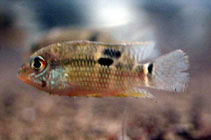 Aequidens tubicen
Afbeelding van Dubosc, J.
Afbeeldingen | Google afbeelding
Afbeelding van Dubosc, J.
Classificatie / Namen Lokale namen | Synoniemen | Catalog of Fishes(Genus, Soort(en)) | ITIS | CoL | WoRMS | Cloffa
> Cichliformes (Cichlids, convict blennies) > Cichlidae (Cichlids) > Cichlinae
Etymology: Aequidens: Latin, aequus, equal, equally + Latin, dens, dentis = teeth (Ref. 45335); tubicen: Name from Latin word meaning trumpeter, referring to the river drainage, the Trombetas, to which the species seems to he restricted; and Portuguese 'trombetas' means trumpets.
More on authors: Kullander & Ferreira.
Etymology: Aequidens: Latin, aequus, equal, equally + Latin, dens, dentis = teeth (Ref. 45335); tubicen: Name from Latin word meaning trumpeter, referring to the river drainage, the Trombetas, to which the species seems to he restricted; and Portuguese 'trombetas' means trumpets.
More on authors: Kullander & Ferreira.
Milieu: milieu / Klimaatzone / Diepte / verspreidingsgebied Ecologie
; zoet water benthopelagisch. Tropical
Verspreiding Gebieden | FAO regio's | Ecosystemen | Voorkomen | Verspreidingskaart | Introducties | Faunafri
South America: Amazon River basin, restricted to Trombetas River close to Cachoeira Porteira, Brazil.
Grootte / Gewicht / Leeftijd
Korte beschrijving Determinatiesleutels | Morfologie | Morfometrie
This species is moderately large (to almost 12 cm) with triserial predorsal scale pattern, relatively long pectoral fin (32.5-37.7% of SL) and 25-26 scales in the E1 row. It is most similar to A. pallidus, both with an enhanced, wide, light spot anterior to the caudal spot, lateral band high on side, posteriorly positioned midlateral spot and high vertebral number (usually 14 + 13 = 27). It differs from A. pallidus in colour pattern which includes characteristics unique for the genus: an irregularly rounded blackish spot at the corner of the preopercle and adjacent cheek; lateral band running from head to dorsal margin of caudal peduncle, interrupted by a large, elongate midlateral spot and subdivided into 2 or 3 elongate spots posteriorly; midlateral spot contiguous with or only narrowly separated from a wide dark bar running dorsally to the base of the dorsal fin, the spot and bar together forming a strongly oblique, backwards slanting vertical marking (Ref. 86501).
Body shape (shape guide): fusiform / normal.
Body shape (shape guide): fusiform / normal.
Prefers small, fast running creeks and rapids. Feeds on fish, insects and plant detritus.
Levenscyclus en paargedrag Maturiteit | Voortplanting | Paaien | Eieren | Fecunditeit | Larven
Hoofdreferentie
Upload uw referenties | Referenties | Coördinator : Kullander, Sven O. | Medewerkers
Kullander, S.O., 2003. Cichlidae (Cichlids). p. 605-654. In R.E. Reis, S.O. Kullander and C.J. Ferraris, Jr. (eds.) Checklist of the Freshwater Fishes of South and Central America. Porto Alegre: EDIPUCRS, Brasil. (Ref. 36377)
Status op de Rode Lijst van het IUCN (Ref. 130435: Version 2025-2 (Global))
Niet bedreigd (LC) ; Date assessed: 07 November 2018
CITES
Not Evaluated
Gevaar voor de mens
Harmless
Gebruik door de mens
FAO - Publication: search | FishSource |
Meer informatie
Trofische ecologie
Voedsel (prooien)
Dieetsamenstelling
Voedselconsumptie
Voedselrantsoenen
Predatoren
Voedsel (prooien)
Dieetsamenstelling
Voedselconsumptie
Voedselrantsoenen
Predatoren
Populatiedynamica
Groeiparameters
Max. leeftijden / maten
Lengte-gewicht rel.
Lengte-lengte rel.
Lengtefrequenties
Massaconversie
Rekrutering
Abundantie
Groeiparameters
Max. leeftijden / maten
Lengte-gewicht rel.
Lengte-lengte rel.
Lengtefrequenties
Massaconversie
Rekrutering
Abundantie
Levenscyclus
Voortplanting
Maturiteit
Rijpheid/kieuwen rel.
Fecunditeit
Paaien
Paaibestanden
Eieren
Ontwikkeling van de eieren
Larven
Larvale populatiedynamiek
Voortplanting
Maturiteit
Rijpheid/kieuwen rel.
Fecunditeit
Paaien
Paaibestanden
Eieren
Ontwikkeling van de eieren
Larven
Larvale populatiedynamiek
Anatomie
Kieuwoppervlak
Hersenen
Otoliet
Kieuwoppervlak
Hersenen
Otoliet
Fysiologie
Lichaamssamenstelling
Voedingsstoffen
Zuurstofverbruik
Type zwemmen
Zwemsnelheid
Visuele pigmenten
Vis geluid
Ziekten en parasieten
Toxiciteit (LC50)
Lichaamssamenstelling
Voedingsstoffen
Zuurstofverbruik
Type zwemmen
Zwemsnelheid
Visuele pigmenten
Vis geluid
Ziekten en parasieten
Toxiciteit (LC50)
Genetica
genoom
Genetica
Heterozygositeit
Erfelijkheid
Genetische diversiteit
genoom
Genetica
Heterozygositeit
Erfelijkheid
Genetische diversiteit
Menselijk gerelateerd
Aquacultuursystemen
Aquacultuurprofielen
Kweeklijnen
Ciguatera gevallen
Postzegels, munten, diversen.
Aquacultuursystemen
Aquacultuurprofielen
Kweeklijnen
Ciguatera gevallen
Postzegels, munten, diversen.
Tools
Speciale rapporten
Bekijk gegevens voor het houden in een aquarium | Bekijk Fact Sheets voor de soort | Bekijk Aquacultuur Fact Sheets
Download XML
Internetbronnen
AFORO (otoliths) | Aquatic Commons | BHL | Cloffa | Websites from users | Bekijk FishWatcher | CISTI | Catalog of Fishes: Genus, Soort(en) | DiscoverLife | ECOTOX | FAO - Publication: search | Faunafri | Fishipedia | Fishtrace | GloBI | Google Books | Google Scholar | Google | IGFA World Record | OneZoom | Open Tree of Life | Otolith Atlas of Taiwan Fishes | PubMed | Reef Life Survey | Socotra Atlas | TreeBase | Tree of Life | Wikipedia: ga naar, zoek | World Records Freshwater Fishing | Zoobank | Zoological Record
Schattingen op basis van modellen
Fylogenetische diversiteitsindex (Ref. 82804): PD50 = 0.5000 [Uniqueness, from 0.5 = low to 2.0 = high].
Bayesian length-weight: a=0.01445 (0.00665 - 0.03141), b=3.08 (2.90 - 3.26), in cm total length, based on LWR estimates for this (Sub)family-body shape (Ref. 93245).
Trofisch niveau (Ref. 69278): 3.2 ±0.48 se; based on food items.
Weerstandsvermogen (Ref. 120179): Gemiddeld, minimale populatieverdubbelingstijd 1,4-4,4 jaar (Assuming Fec<1000).