



Add your observation in Fish Watcher
| Native range | All suitable habitat | Point map | Year 2050 |

|
| This map was computer-generated and has not yet been reviewed. |
| Hypanus marianae AquaMaps Data sources: GBIF OBIS |
Upload your photos and videos
Pictures | Google image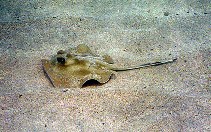 Hypanus marianae
Picture by Sazima, I.
Pictures | Google image
Picture by Sazima, I.
Classification / Names Common names | Synonyms | Catalog of Fishes(genus, species) | ITIS | CoL | WoRMS | Cloffa
Elasmobranchii (sharks and rays) > Myliobatiformes (Stingrays) > Dasyatidae (Stingrays) > Dasyatinae
Etymology: marianae: Named for Mariana R. Oliveria, daughter of Otto B.F. Gadig.
Eponymy: Mariana Ramos de Oliveira Gadig is the daughter of Otto Gadig, the third author. She works as a microbiologist at Prefeitura Municipal de Santos, Brazil. She is also a psychologist in private practice. [Sketch modified on the request of M. Ramos herself]. (Ref. 128868), visit book page.
Etymology: marianae: Named for Mariana R. Oliveria, daughter of Otto B.F. Gadig.
Eponymy: Mariana Ramos de Oliveira Gadig is the daughter of Otto Gadig, the third author. She works as a microbiologist at Prefeitura Municipal de Santos, Brazil. She is also a psychologist in private practice. [Sketch modified on the request of M. Ramos herself]. (Ref. 128868), visit book page.
Environment: milieu / climate zone / depth range / distribution range Ecology
Distribution Territories | FAO areas | Ecosystems | Occurrences | Point map | Introductions | Faunafri
Southwest Atlantic: along the northeastern Brazilian coast, from the state of Maranhão to southern Bahia.
Size / Weight / Age
Short description Identification keys | Morphology | Morphometrics
This medium-sized species of Dasyatis is distinguished by the following characters: horizontal diameter of eye nearly equal to interorbital width and spiracle length; its tail is relatively short, less than two times disk width, distally filiform, with dorsal and ventral finfolds, ending approximately on same vertical line; height of dorsal finfold 1.5-2 in height of ventral finfold; the dorsal surface of disc is yellowish brown, with dark blotch between spiracles and two pairs of dark scapular and precaudal blotches; margins of disc and pelvic fins are blue dorsally; the ventral surface of disc white, with two symmetrical pairs of dark markings in adults (Ref. 36974).
Body shape (shape guide): other; Cross section: flattened.
Body shape (shape guide): other; Cross section: flattened.
Apparently associated with coral or sandstone reefs of the northeastern Brazilian continental shelf. Two female specimens were collected from the stomach of Rachycentron canadum (Ref. 36974). Juveniles also occurred in sandy beaches and estuaries. Ovoviviparous (Ref. 50449).
Life cycle and mating behavior Maturity | Reproduction | Spawning | Eggs | Fecundity | Larvae
Exhibit ovoviparity (aplacental viviparity), with embryos feeding initially on yolk, then receiving additional nourishment from the mother by indirect absorption of uterine fluid enriched with mucus, fat or protein through specialised structures (Ref. 50449). Distinct pairing with embrace (Ref. 205). A gravid female aborted one fully formed embryo (Ref. 36974).
Main reference
Upload your references | References | Coordinator : McEachran, John | Collaborators
Gomes, U.L., R.S. Rosa and O.B.F. Gadig, 2000. Dasyatis marianae sp. n.: a new species of stingray (Chondrichthyes: Dasyatidae) from the southwestern Atlantic. Copeia 2000(2):510-515. (Ref. 36974)
IUCN Red List Status (Ref. 130435: Version 2025-2 (Global))
Endangered (EN) (A2cd); Date assessed: 01 July 2019
CITES
Not Evaluated
Threat to humans
Harmless
Human uses
FAO - Publication: search | FishSource |
More information
Trophic ecology
Food items (preys)
Diet composition
Food consumption
Food rations
Predators
Food items (preys)
Diet composition
Food consumption
Food rations
Predators
Ecology
Ecology
Ecology
Population dynamics
Growth parameters
Max. ages / sizes
Length-weight rel.
Length-length rel.
Length-frequencies
Mass conversion
Recruitment
Abundance
Growth parameters
Max. ages / sizes
Length-weight rel.
Length-length rel.
Length-frequencies
Mass conversion
Recruitment
Abundance
Life cycle
Reproduction
Maturity
Maturity/Gills rel.
Fecundity
Spawning
Spawning aggregations
Eggs
Egg development
Larvae
Larval dynamics
Reproduction
Maturity
Maturity/Gills rel.
Fecundity
Spawning
Spawning aggregations
Eggs
Egg development
Larvae
Larval dynamics
Anatomy
Gill area
Brain
Otolith
Gill area
Brain
Otolith
Physiology
Body composition
Nutrients
Oxygen consumption
Swimming type
Swimming speed
Visual pigments
Fish sound
Diseases & Parasites
Toxicity (LC50s)
Body composition
Nutrients
Oxygen consumption
Swimming type
Swimming speed
Visual pigments
Fish sound
Diseases & Parasites
Toxicity (LC50s)
Genetics
Genome
Genetics
Heterozygosity
Heritability
Genetic Diversity
Genome
Genetics
Heterozygosity
Heritability
Genetic Diversity
Human related
Aquaculture systems
Aquaculture profiles
Strains
Ciguatera cases
Stamps, coins, misc.
Aquaculture systems
Aquaculture profiles
Strains
Ciguatera cases
Stamps, coins, misc.
Tools
Special reports
Download XML
Internet sources
AFORO (otoliths) | Aquatic Commons | BHL | Cloffa | Websites from users | Check FishWatcher | CISTI | Catalog of Fishes: genus, species | DiscoverLife | ECOTOX | FAO - Publication: search | Faunafri | Fishipedia | Fishtrace | GloBI | Google Books | Google Scholar | Google | IGFA World Record | OneZoom | Open Tree of Life | Otolith Atlas of Taiwan Fishes | PubMed | Reef Life Survey | Socotra Atlas | TreeBase | Tree of Life | Wikipedia: Go, Search | World Records Freshwater Fishing | Zoological Record
Estimates based on models
Preferred temperature (Ref. 123201): 27 - 27.9, mean 27.4 °C (based on 44 cells).
Phylogenetic diversity index (Ref. 82804): PD50 = 0.5010 [Uniqueness, from 0.5 = low to 2.0 = high].
Bayesian length-weight: a=0.01023 (0.00626 - 0.01674), b=3.15 (3.02 - 3.28), in cm total length, based on LWR estimates for this species & (Sub)family-body (Ref. 93245).
Trophic level (Ref. 69278): 3.5 ±0.5 se; based on size and trophs of closest relatives
Resilience (Ref. 120179): Very Low, minimum population doubling time more than 14 years (Fec=2).