>
Cypriniformes (Carps) >
Nemacheilidae (Brook loaches)
Etymology: Schistura: Greek, schizein = to divide + Greek, oura = tail; an allusion to forked caudal fins (Ref. 45335); pertica: From the Latin pertica (pole), a reference to the long, slender, rounded body.
More on author: Kottelat.
Environment: milieu / climate zone / rango de profundidad / distribution range
Ecología
; agua dulce bentopelágico. Tropical
Asia: Laos (Nam Ou basin) and Yunnan, China
Tamaño / Peso / Age
Madurez: Lm ? range ? - ? cm
Max length : 6.6 cm SL macho / no sexado; (Ref. 36949)
Short description
Claves de identificación | Morfología | Morfometría
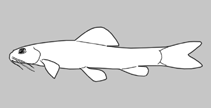
Body elongate, slightly compressed, depth more or less uniform from head to caudal-fin base; head depressed, lateral head length 19.0-22.6 %SL; body depth 13.8-15.8 %SL; caudal peduncle length 16.6-18.9 %SL, depth 11.0-11.9 %SL, 1.44-1.70 times in length; anterior nostril pierced on front side of a flap; processus dentiformis present; no median notch in upper lip, lower lip with a median interruption; lower jaw with a median notch; lateral line complete; anus about 1-2 eye diameters in front of anal-fin origin; 8.5 branched dorsal-fin rays; 5.5 branched anal-fin rays; caudal fin emarginate, with 9+8 branched rays; axillary pelvic lobe present; body with 12-18 bars, narrower than or as wide as interspaces, sometimes very regularly shaped and set but usually irregularly shaped, incomplete, or interrupted, anterior ones often incomplete or fused at upper extremity but not meeting counterparts of other body side on back, leaving a narrow pale dorsal midline stripe, outlined on each side by a dark stripe; black bar at caudal-fin base incomplete, not reaching dorsal and ventral midlines, relatively broad and irregularly shaped, often split or with a constriction separating a black dot at upper extremity; a pale triangle in front of bar along both dorsal and ventral midlines; dorsal-fin base with an anterior black spot, followed by an orange patch and a low elongate grey blotch (Ref. 36949).
Body shape (shape guide): elongated; Cross section: compressed.
Life cycle and mating behavior
Madurez | Reproducción | Puesta | Huevos | Fecundidad | Larva
Kottelat, M., 2000. Diagnosis of a new genus and 64 new species of fishes from Laos (Teleostei: Cyprinidae, Balitoridae, Bagridae, Syngnathidae, Chaudhuriidae and Tetraodontidae). J. South Asian Nat. Hist. 5(1):37-82. (Ref. 36949)
IUCN Red List Status (Ref. 130435: Version 2025-1)
Threat to humans
Harmless
Human uses
Herramientas
Special reports
Download XML
Fuentes de Internet
Estimates based on models
Phylogenetic diversity index (Referencia
82804): PD
50 = 0.5000 [Uniqueness, from 0.5 = low to 2.0 = high].
Bayesian length-weight: a=0.00692 (0.00310 - 0.01545), b=3.02 (2.85 - 3.19), in cm total length, based on LWR estimates for this Genus-body shape (Ref.
93245).
Nivel trófico (Referencia
69278): 3.0 ±0.3 se; based on size and trophs of closest relatives
Resiliencia (Referencia
120179): Medio, población duplicada en un tiempo mínimo de 1.4-4.4 años (Preliminary K or Fecundity.).
Fishing Vulnerability (Ref.
59153): Low vulnerability (10 of 100).
🛈