Classification / Names
Populärnamn | synonymer | Catalog of Fishes(Släkte, Arter) | ITIS | CoL | WoRMS | Cloffa
>
Cypriniformes (Carps) >
Gastromyzontidae (Hillstream loaches)
Etymology: crassicauda: From the Latin crassus (thick) and cauda (tail), allusion to the stout caudal peduncle.
Eponymy: Mari Albert Johan Van Manen (1877–1943) was a Dutch ethnographer, theosophist and orientalist who made a specialty of the study of Tibet and its texts. [...] (Ref. 128868), visit book page.
More on author: Kottelat.
Environment: milieu / climate zone / djupintervall / distribution range
Ekologi
; sötvatten bottenlevande. Tropical
Asia: Nam Xam and Nam Ma basins in Laos. Expected to occur in Viet Nam.
Size / Vikt / Age
Könsmognad: Lm ? range ? - ? cm
Max length : 6.7 cm SL hane/ej könsbestämd; (Ref. 43281)
Short description
Bestämningsnycklar | Morfologi | Morfometri
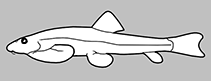
Caudal peduncle 1.2-1.5 times longer than deep, depth 9.3-10.7 %SL; anus closer to posterior extremity of pelvic-fin base than to caudal-fin origin; 12-16 black bars on body, their width about equal to eye diameter, quite regularly shaped and spaced in individuals larger than about 50 mm SL, less regular in smaller ones; juvenile with 3 broad black bars on body and a large black blotch on anterior half of caudal fin; 7-8 narrow saddles along back; pelvic, pectoral and anal fins plain colored, bright orange in life; 2 broad black stripes or row of spots on dorsal, 3 black bars or rows of spots on caudal fin; 15-16 branched pectoral-fin rays; 9 branched pelvic-fin rays (Ref. 36949).
Body shape (shape guide): elongated; Cross section: compressed.
Occurs in rapids, torrents and waterfalls (Ref. 36949).
Life cycle and mating behavior
Könsmognad | Reproduktion | Lek | Ägg | Fecundity | Larver
Kottelat, M., 2001. Fishes of Laos. WHT Publications Ltd., Colombo 5, Sri Lanka. 198 p. (Ref. 43281)
IUCN Red List Status (Ref. 130435: Version 2025-1)
Threat to humans
Harmless
Human uses
Verktyg
Special reports
Download XML
Internet-källor
Estimates based on models
Phylogenetic diversity index (Ref.
82804): PD
50 = 0.5000 [Uniqueness, from 0.5 = low to 2.0 = high].
Bayesian length-weight: a=0.00617 (0.00268 - 0.01421), b=3.11 (2.91 - 3.31), in cm total length, based on LWR estimates for this (Sub)family-body shape (Ref.
93245).
Trofisk nivå (Ref.
69278): 2.7 ±0.2 se; based on size and trophs of closest relatives
Fishing Vulnerability (Ref.
59153): Low vulnerability (10 of 100).
🛈