>
Cypriniformes (Carps) >
Nemacheilidae (Brook loaches)
Etymology: Schistura: Greek, schizein = to divide + Greek, oura = tail; an allusion to forked caudal fins (Ref. 45335); tizardi: Named for Robert Tizard, in gratitude for his help.
Eponymy: Robert John Tizard (d: 1971) is currently Senior Technical Advisor at the Wildlife Conservation Society (2005–2015) and also on the Board of Directors of Village Focus International (2001–2015). [...] (Ref. 128868), visit book page.
More on author: Kottelat.
Environment: milieu / climate zone / rango de profundidad / distribution range
Ecología
; agua dulce bentopelágico. Tropical
Asia: Mekong at the Xe Kong basin in Laos.
Tamaño / Peso / Age
Madurez: Lm ? range ? - ? cm
Max length : 4.9 cm SL macho / no sexado; (Ref. 43281)
Short description
Claves de identificación | Morfología | Morfometría
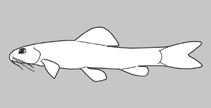
Body cylindrical, its greatest depth in front of dorsal-fin origin, sometimes with a small hump; head flat with straight to concave dorsal profile and depressed snout; eyes slightly protruding above dorsal profile of head; anterior nostril pierced on front side of a flap; processus dentiformis present; no median notch in upper lip, median incision in lower lip; shallow median notch in lower jaw; lateral line complete; anus about 1-2 eye diameters in front of anal-fin origin; 8.5 branched dorsal-fin rays; 5.5 branched anal-fin rays; caudal fin emarginate, with 9+8 branched rays; axillary pelvic lobe present; body with 7-9 bars, wider than interspaces, not very contrasted in front of dorsal-fin origin, not very regular; black bar at caudal-fin base almost complete but faint, often only contrasted on middle half of base, not reaching dorsal and ventral midlines; dorsal-fin base with a black spot anteriorly, followed by an orange spot and an elongate grey blotch; base of rays of upper caudal-fin lobe orange with a cloud of black pigments; body sometimes plain dark brown (Ref. 36949).
Body shape (shape guide): elongated; Cross section: circular.
Found in main rivers, on gravel beds (Ref. 36949).
Life cycle and mating behavior
Madurez | Reproducción | Puesta | Huevos | Fecundidad | Larva
Kottelat, M., 2001. Fishes of Laos. WHT Publications Ltd., Colombo 5, Sri Lanka. 198 p. (Ref. 43281)
IUCN Red List Status (Ref. 130435: Version 2025-1)
Threat to humans
Harmless
Human uses
Herramientas
Special reports
Download XML
Fuentes de Internet
Estimates based on models
Phylogenetic diversity index (Referencia
82804): PD
50 = 0.5000 [Uniqueness, from 0.5 = low to 2.0 = high].
Bayesian length-weight: a=0.00692 (0.00310 - 0.01545), b=3.02 (2.85 - 3.19), in cm total length, based on LWR estimates for this Genus-body shape (Ref.
93245).
Nivel trófico (Referencia
69278): 3.0 ±0.3 se; based on size and trophs of closest relatives
Resiliencia (Referencia
120179): Alto, población duplicada en un tiempo mínimo inferior a 15 meses (Preliminary K or Fecundity.).
Fishing Vulnerability (Ref.
59153): Low vulnerability (10 of 100).
🛈