>
Eupercaria/misc (Various families in series Eupercaria) >
Labridae (Wrasses) > Cheilininae
Etymology: Cirrhilabrus: Latin, cirrus = curl fringe + Greek, labros = furious (Ref. 45335); katoi: Named for Mr. Shoichi Kato, who collected the first specimen (holotype).
Eponymy: Shoichi Kato (d: 1957) is a PADI diving instructor who has run Regulus Diving on Hachijo Island, Japan, since he opened it (1992). [...] (Ref. 128868), visit book page.
Environment: milieu / climate zone / Tiefenbereich / distribution range
Ökologie
seewasser demersal; tiefenbereich 20 - 40 m (Ref. 36346). Temperate
Northwest Pacific: Japan.
Size / Gewicht / Alter
Geschlechtsreife: Lm ? range ? - ? cm
Max length : 7.5 cm SL Männchen/unbestimmt; (Ref. 36346); 4.9 cm SL (female)
Kurzbeschreibung
Bestimmungsschlüssel | Morphologie | Morphometrie
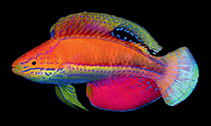
Rückenflossenstacheln (insgesamt) : 11; Rückenflossenweichstrahlen (insgesamt) : 9; Afterflossenstacheln: 3; Afterflossenweichstrahlen: 9; Wirbelzahl: 25. Median predorsal scales 4-5; horizontal scale rows on cheek below eye 2; body depth 3.3-3.5 in SL; head length 2.5-2.9 in SL; snout length 3.1-3.7 in head; Head and body scarlet above level of lower margin of eye; lower part of body orange-yellow with five broken rose-pink lines; head with several, longitudinal, irregular rose pink lines or rows of spots (Ref. 36346).
Body shape (shape guide): fusiform / normal; Cross section: compressed.
Observations at Kashiwa-jima Island and in adjacent waters showed the species to form aggregations comprising one or two males and several females, pairs, or solitary to several females. In some cases, single male appeared to maintain harems of several females. This species often forms aggregations with Cirrhilabrus cyanopleura, C. lunatus, C. rubrimarginatus and C. temminckii, over rocky substrata (Ref. 36346).
Life cycle and mating behavior
Geschlechtsreife | Fortpflanzung | Ablaichen | Eier | Fecundity | Larven
Distinct pairing during breeding (Ref. 205).
Senou, H. and T. Hirata, 2000. A new labrid fish, Cirrhilabrus katoi, from southern Japan. Ichthyol. Res. 47(1):89-93. (Ref. 36346)
IUCN Rote Liste Status (Ref. 130435: Version 2025-1)
Bedrohung für Menschen
Harmless
Nutzung durch Menschen
Tools
Zusatzinformationen
Download XML
Internet Quellen
Estimates based on models
Phylogenetic diversity index (Ref.
82804): PD
50 = 0.5000 [Uniqueness, from 0.5 = low to 2.0 = high].
Bayesian length-weight: a=0.01585 (0.00700 - 0.03587), b=2.95 (2.76 - 3.14), in cm total length, based on LWR estimates for this (Sub)family-body shape (Ref.
93245).
Trophic level (Ref.
69278): 3.3 ±0.4 se; based on size and trophs of closest relatives
Widerstandsfähigkeit (Ref.
120179): hoch, Verdopplung der Population dauert weniger als 15 Monate. (Preliminary K or Fecundity.).
Fishing Vulnerability (Ref.
59153): Low vulnerability (10 of 100).
🛈