>
Characiformes (Characins) >
Serrasalmidae (Piranhas and pacus) > Serrasalminae
Etymology: Serrasalmus: Latin, serran, serranus, saw and a fish of genus Serranus + Latin, salmo = salmon (Ref. 45335).
More on author: Kner.
Issue
Eschmeyer (1998: 994) syntype designation of BMNH 1928.1.24:10 Myletes maculatus Kner 1858 currently placed under Metynnis, is erroneous. Recent (10 Feb. 1978) and local syntype designations of NMW 57058 collected from Rio Negro, Brazil are erroneous. See Jégu & Santos (2001) for detailed morphology and distribution. See Martins-Santos, Julio-Jr. & Santos (1994) and Nakayama, Porto & Feldberg (2000) for cytogenetic study.
Environment: milieu / climate zone / intervalo de profundidade / distribution range
Ecologia
; Água doce pelágico(a,os,as). Tropical
South America: Amazon and Paraguay-Paraná River basins (Ref. 39031). Recorded from the Uruguay River (Ref. 79585).
Length at first maturity / Tamanho / Peso / Idade
Maturidade: Lm 10.8 range ? - ? cm
Max length : 26.4 cm TL macho/indeterminado; (Ref. 115169); 34.5 cm TL (female); peso máx. Publicado: 420.00 g (Ref. 115169); peso máx. Publicado: 420.00 g
Descrição breve
Chaves de identificação | Morfologia | Morfometria
Raios dorsais moles (total) : 16; Raios anais moles: 33 - 35; Vértebras: 36.
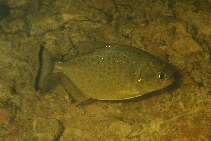
Body shape (shape guide): short and / or deep; Cross section: compressed.
Occurs usually in small groups of up to 20 individuals which appear to have a definite range within a pond or a creek. Observed to be active mainly during the day. Larger fish extend their foraging until about 9 at night. where it stays in the shallows near the bottom, sheltered among vegetation (Ref. 9080). Larvae and juveniles hide and feed within the root tangle of water hyacinths, which also act as a dispersal agent during floods (Ref. 40399). Larvae feed on
microscopic crustaceans and small aquatic insects; very small size juveniles (about 1.2 cm)
already clip fins of other fishes (Ref. 40399). Juveniles and adults feed mostly on fins and muscle portions of fishes (Ref. 9080, 40398). Adults may scavenge on dead mammals, including humans (Ref. 40400). Attacks on humans with bite outbreaks may occur in dammed
portions of rivers during the breeding season, related to brood protection by the spawning
adults (Ref. 50802).
Life cycle and mating behavior
Maturidade | Reprodução | Desova | Ovos | Fecundidade | Larvas
Jégu, M., 2003. Serrasalminae (Pacus and piranhas). p. 182-196. In R.E. Reis, S.O. Kullander and C.J. Ferraris, Jr. (eds.) Checklist of the Freshwater Fishes of South and Central America. Porto Alegre: EDIPUCRS, Brasil. (Ref. 39031)
Categoria na Lista Vermelha da IUCN (Ref. 130435: Version 2025-1)
Ameaça para o homem
Traumatogenic (Ref. 50802)
Utilização humana
Ferramentas
Relatórios especiais
Descarregue XML
Fontes da internet
Estimates based on models
Phylogenetic diversity index (Ref.
82804): PD
50 = 0.5000 [Uniqueness, from 0.5 = low to 2.0 = high].
Bayesian length-weight: a=0.01622 (0.01337 - 0.01967), b=3.17 (3.13 - 3.21), in cm total length, based on LWR estimates for this species (Ref.
93245).
Nível Trófico (Ref.
69278): 4.1 ±0.71 se; based on food items.
Resiliência (Ref.
120179): Elevada, tempo mínimo de duplicação da população menor que 15 meses (Preliminary K or Fecundity.).
Fishing Vulnerability (Ref.
59153): Low vulnerability (25 of 100).
🛈