Environment: milieu / climate zone / profondeur / distribution range
Écologie
marin récifal; profondeur ? - 400 m (Ref. 100719). Tropical; 30°N - 36°S, 24°E - 171°E
Indo-West Pacific: Red Sea and Sodwana Bay, South Africa (Ref. 4313) to the Mariana Islands (Ref. 9710), north to Taiwan; Palau and Guam in Micronesia; probably more widespread.
Taille / Poids / Âge
Maturité: Lm ? range ? - ? cm
Max length : 36.0 cm TL mâle / non sexé; (Ref. 9710); common length : 30.0 cm SL mâle / non sexé; (Ref. 37816)
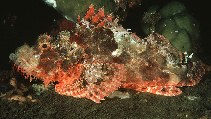
Épines dorsales (Total) : 12; Rayons mous dorsaux (Total) : 9; Épines anales: 3; Rayons mous anaux: 5. Highly variable in color. Adults 'bearded' with numerous tassels. Juveniles slender with tall dorsal fin (Ref. 48635). Third dorsal spine longest (2.05-2.5) in head; occipital pit absent or very shallow; snout very long (2.7-3.0 in head length); space between opercular spines naked; first dorsal spine short (1.85-2.5) in length of second spine; supraocular and postocular spines broadly joined in adults (only tip of supraocular spine showing) and flaring outward to form a shelf over posterior half of eye (Ref 42181).
Body shape (shape guide): fusiform / normal.
Inhabits clear-water outer reef slopes and channels from depths of 1 to at least 35 m, in areas with mixed rock and coral substrates. Venomous spines. Solitary on coral and rocky bottoms (Ref 90102).
Life cycle and mating behavior
Maturité | Reproduction | Frai | Œufs | Fécondité | Larves
Myers, R.F., 1991. Micronesian reef fishes. Second Ed. Coral Graphics, Barrigada, Guam. 298 p. (Ref. 1602)
Statut dans la liste rouge de l'IUCN (Ref. 130435: Version 2025-1)
Utilisations par l'homme
Outils
Articles particuliers
Télécharger en XML
Sources Internet
Estimates based on models
Preferred temperature (Réf.
123201): 20.3 - 28.3, mean 26.5 °C (based on 973 cells).
Phylogenetic diversity index (Réf.
82804): PD
50 = 0.5000 [Uniqueness, from 0.5 = low to 2.0 = high].
Bayesian length-weight: a=0.01549 (0.00901 - 0.02662), b=3.11 (2.96 - 3.26), in cm total length, based on LWR estimates for this species & (Sub)family-body (Ref.
93245).
Niveau trophique (Réf.
69278): 3.9 ±0.63 se; based on food items.
Résilience (Réf.
120179): Faible, temps minimum de doublement de population : 4,5 à 14 années (Preliminary K or Fecundity.).
Fishing Vulnerability (Ref.
59153): Low to moderate vulnerability (26 of 100).
🛈
Nutrients (Ref.
124155): Calcium = 40.3 [19.1, 89.5] mg/100g; Iron = 0.523 [0.282, 1.489] mg/100g; Protein = 18.2 [16.3, 20.2] %; Omega3 = 0.247 [0.109, 0.685] g/100g; Selenium = 48.3 [25.0, 121.0] μg/100g; VitaminA = 110 [38, 316] μg/100g; Zinc = 1.12 [0.77, 1.62] mg/100g (wet weight);