>
Eupercaria/misc (Various families in series Eupercaria) >
Nemipteridae (Threadfin breams, Whiptail breams)
Etymology: Nemipterus: Greek, nema, -atos = filament + Greek, pteron = wing, fin (Ref. 45335).
Eponymy: Dr John ‘Jack’ Ernest Randall Jr. [...] (Ref. 128868), visit book page.
Environment: milieu / climate zone / Tiefenbereich / distribution range
Ökologie
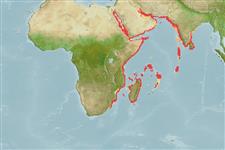
seewasser demersal; standorttreu; tiefenbereich 20 - 450 m (Ref. 100719). Tropical; 31°N - 30°S, 31°E - 99°E (Ref. 3810)
Western Indian Ocean: including the east and west coast of India, Pakistan, Persian Gulf, Red Sea, Gulf of Aden, east African coast, Seychelles and Madagascar, east to Myanmar. A Lessepsian migrant (Ref. 84163). This species has been previously misidentified as Nemipterus mesoprion.
Length at first maturity / Size / Gewicht / Alter
Geschlechtsreife: Lm 15.6 range ? - ? cm
Max length : 27.0 cm TL Männchen/unbestimmt; (Ref. 124816); common length : 15.0 cm SL Männchen/unbestimmt; (Ref. 3810); max. veröff. Gewicht: 330.00 g (Ref. 124816); max. veröff. Alter: 3.00 Jahre (Ref. 96857)
Rückenflossenstacheln (insgesamt) : 10; Rückenflossenweichstrahlen (insgesamt) : 9; Afterflossenstacheln: 3; Afterflossenweichstrahlen: 7. Suborbital spine absent. Preopercle with 3 transverse scale rows. Pectoral and pelvic fins very long, reaching to or just beyond level of origin of anal fin. A line drawn up from posterior edge of suborbital reaching the dorsal profile at about 3 to 7 scale rows before origin of dorsal fin. Upper lobe of caudal fin produced into a long trailing light red filament. Axillary scale present. Color: Body silvery pink. Peritoneum salmon-pink.
Body shape (shape guide): fusiform / normal; Cross section: oval.
Benthic on sand or mud bottoms (Ref. 30573). No major fishery exists, but a large population is believed to occur in the Persian Gulf. Minimum depth reported taken from Ref. 127989.
Russell, B.C., 1990. FAO Species Catalogue. Vol. 12. Nemipterid fishes of the world. (Threadfin breams, whiptail breams, monocle breams, dwarf monocle breams, and coral breams). Family Nemipteridae. An annotated and illustrated catalogue of nemipterid species known to date. FAO Fish. Synop. 125(12):149p. Rome: FAO. (Ref. 3810)
IUCN Rote Liste Status (Ref. 130435: Version 2025-1)
Bedrohung für Menschen
Harmless
Nutzung durch Menschen
Fischereien: weniger kommerziell
Tools
Zusatzinformationen
Download XML
Internet Quellen
Estimates based on models
Preferred temperature (Ref.
123201): 15.0635 - 24.7625, mean 21.42 °C (based on 148 cells).
Phylogenetic diversity index (Ref.
82804): PD
50 = 0.5000 [Uniqueness, from 0.5 = low to 2.0 = high].
Bayesian length-weight: a=0.01318 (0.01101 - 0.01579), b=2.95 (2.92 - 2.98), in cm total length, based on LWR estimates for this species (Ref.
93245).
Trophic level (Ref.
69278): 3.8 ±0.5 se; based on size and trophs of closest relatives
Widerstandsfähigkeit (Ref.
120179): mittel, Verdopplung der Population dauert 1,4 - 4,4 Jahre. (K=0.83; tmax=3; tm=3.2 Fec=26,091).
Fishing Vulnerability (Ref.
59153): Low vulnerability (18 of 100).
🛈
Climate Vulnerability (Ref.
125649): Moderate vulnerability (38 of 100).
🛈
Nutrients (Ref.
124155): Calcium = 514 [115, 1,025] mg/100g; Iron = 1.47 [0.47, 4.01] mg/100g; Protein = 18 [16, 20] %; Omega3 = 0.338 [0.163, 0.767] g/100g; Selenium = 65.5 [24.9, 176.2] μg/100g; VitaminA = 7.37 [1.70, 39.77] μg/100g; Zinc = 0.811 [0.466, 2.772] mg/100g (wet weight);