>
Anguilliformes (Eels and morays) >
Muraenidae (Moray eels) > Muraeninae
Etymology: Gymnothorax: Greek, gymnos = naked + Greek, thorax, -akos = breast (Ref. 45335); pseudoherrei: Named for its superficial similarity to and confusion with Gymnothorax herrei Beebe & Tee-Van (1933).
Environment: milieu / Klimaatzone / Diepte / distribution range
Ecologie
marien demersaal; diepte 1 - 22 m (Ref. 90102). Tropical
Indo-West Pacific: Maldive Is. and Sri Lanka to Thailand, Indonesia, northern Australia, the Philippines, Papua New Guinea, New Britain, Palau, and the Solomon Is.
Grootte / Gewicht / Leeftijd
Maturiteit: Lm ? range ? - ? cm
Max length : 20.0 cm TL mannelijk / geslacht onbekend; (Ref. 132087)
Korte beschrijving
Determinatiesleutels | Morfologie | Morfometrie
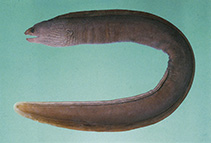
Wervels: 111 - 116. This species is small size in size (to about 20.0 cm TL) is distinguished by the following characters: dorsal-fin origin is before the gill opening; maxillary teeth are biserial; branchial pores 2; total vertebrae 111-116. Colouration: body plain brown, without dark grooves on throat and posterior part of head (Ref. 132087).
Body shape (shape guide): eel-like; Cross section: circular.
Found in coral reefs in 1-15 m (Ref 90102); in shallow water, but with the deepest collection site at 22 m. This small species is distinctly smaller than Gymnothorax arabicus, largest of 84 specimens reported by Böhlke (2000) was only 18.2 cm TL while the living individual from Sri Lanka (USNM 451459) measures approximately 20.0 cm, it has not grown beyond this size in four years. Reported length of a ripe female was 12.3 cm TL, and a specimen of 14.8 cm TL (USNM 210269) was noticeably swollen and contained large eggs (Ref. 132087).
Levenscyclus en paargedrag
Maturiteit | Voortplanting | Paaien | Eieren | Fecunditeit | Larven
Smith, D.G., S.V. Bogorodsky, J. Dandar and U. Zajonz, 2024. A new species of short unpatterned moray eel (Anguilliformes: Muraenidae)
from the northwestern Indian Ocean, including the Socotra Archipelago, with a
redescription of Gymnothorax pseudoherrei Böhlke. Zootaxa 5477(4):465-474. (Ref. 132087)
Status op de Rode Lijst van het IUCN (Ref. 130435: Version 2025-1)
Gevaar voor de mens
Harmless
Gebruik door de mens
Visserij: van minder commercieel belang
Tools
Speciale rapporten
Download XML
Internetbronnen
Estimates based on models
Preferred temperature (Ref.
123201): 26.2 - 29.3, mean 28.6 °C (based on 1527 cells).
Fylogenetische diversiteitsindex (Ref.
82804): PD
50 = 0.5000 [Uniqueness, from 0.5 = low to 2.0 = high].
Bayesian length-weight: a=0.00048 (0.00025 - 0.00091), b=3.28 (3.12 - 3.44), in cm total length, based on LWR estimates for this Genus-body shape (Ref.
93245).
Trofisch niveau (Ref.
69278): 3.6 ±0.6 se; based on size and trophs of closest relatives
Weerstandsvermogen (Ref.
120179): Hoog, minimale populatieverdubbelingstijd minder dan 15 maanden (Preliminary K or Fecundity.).
Fishing Vulnerability (Ref.
59153): Low vulnerability (10 of 100).
🛈