Classification / Names
Nombres comunes | Sinónimos | Catalog of Fishes(Género, Especie) | ITIS | CoL | WoRMS | Cloffa
>
Gymnotiformes (Knifefishes) >
Gymnotidae (Naked-back knifefishes) > Gymnotinae
Etymology: Gymnotus: Greek, gymnos = naked (Ref. 45335); melanopleura: From the Latin melano meaning dark, and the Greek pleura meaning rib or side, in reference to the dark bands along the lateral body durface. Noun in apposition.
Environment: milieu / climate zone / rango de profundidad / distribution range
Ecología
; agua dulce demersal. Subtropical
South America: Mamirauá lake system near Tefé, Amazonas, Brazil and Rio Napo drainage, Loreto, Peru (Ref. 41292). Reported from the upper Amazon River basin, Brazil (Ref. 36692).
Tamaño / Peso / Age
Madurez: Lm ? range ? - ? cm
Max length : 10.0 cm TL macho / no sexado; (Ref. 36692)
Short description
Claves de identificación | Morfología | Morfometría
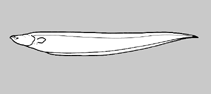
Slender body (body depth 6-10% TL versus 11-13) possess 12 pale bands along entire length of body, about as broad as the dark bands on the posterior half of the body, and a thin pale band extending posteroventrally below the eye to the branchial isthmus.
Body shape (shape guide): elongated; Cross section: circular.
Facultative air-breathing in the genus (Ref. 126274); Collected in a whitewater floating meadow of the floodplain in the Tefé region (Ref. 41292).
Life cycle and mating behavior
Madurez | Reproducción | Puesta | Huevos | Fecundidad | Larva
Albert, J.S. and W.G.R. Crampton, 2001. Five new species of Gymnotus (Teleostei: Gymnotiformes) from an upper Amazon floodplain, with descriptions of electric organ discharges and ecology. Ichthyol. Explor. Freshwat. 12(3):241-266. (Ref. 41292)
IUCN Red List Status (Ref. 130435: Version 2025-1)
Threat to humans
Harmless
Human uses
Herramientas
Special reports
Download XML
Fuentes de Internet
Estimates based on models
Phylogenetic diversity index (Referencia
82804): PD
50 = 0.5000 [Uniqueness, from 0.5 = low to 2.0 = high].
Bayesian length-weight: a=0.00427 (0.00204 - 0.00890), b=2.99 (2.80 - 3.18), in cm total length, based on LWR estimates for this (Sub)family-body shape (Ref.
93245).
Nivel trófico (Referencia
69278): 3.2 ±0.4 se; based on size and trophs of closest relatives
Resiliencia (Referencia
120179): Alto, población duplicada en un tiempo mínimo inferior a 15 meses (Preliminary K or Fecundity.).
Fishing Vulnerability (Ref.
59153): Low vulnerability (10 of 100).
🛈