



Nebrius ferrugineus (Lesson, 1831)
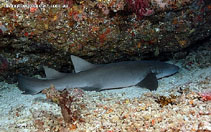
Tawny nurse shark
Aggiungete la vostra osservazione in Fish Watcher
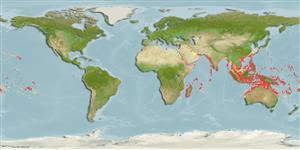
| Native range | All suitable habitat | Point map | Year 2050 |
|
| This map was computer-generated and has not yet been reviewed. |
| Nebrius ferrugineus AquaMaps Data sources: GBIF OBIS |
Classificazione / Nomi Nomi Comuni | Sinonimi | Catalog of Fishes(Genere, Specie) | ITIS | CoL | WoRMS | Cloffa
Elasmobranchi (squali e razze) (sharks and rays) > Orectolobiformes (Carpet sharks) > Ginglymostomatidae (Nurse sharks)
Etymology: Nebrius: Nebrius ferrugineus (Lesson 1831) (See ETYFish); ferrugineus: Latin for rust-colored, referring to brown coloration (See ETYFish).
Etymology: Nebrius: Nebrius ferrugineus (Lesson 1831) (See ETYFish); ferrugineus: Latin for rust-colored, referring to brown coloration (See ETYFish).
Ambiente: milieu / zona climatica / distribuzione batimetrica / gamma di distribuzione Ecologia
marino associati a barriera corallina; distribuzione batimetrica 0 - 70 m (Ref. 106604), usually 5 - 30 m (Ref. 43278). Tropical; 36°N - 27°S, 32°E - 136°W
Distribuzione Territories | Aree FAO | Ecosistemi | Presenze | Mappa dei ritrovamenti | Introduzioni | Faunafri
Indo-Pacific: Persian Gulf (Ref.80050), Red Sea and East Africa to the Tuamoto Islands, north to southern Japan, south to Australia.
Lunghezza alla prima maturità / Dimensione / Peso / Età
Maturità: Lm ?, range 230 - ? cm
Max length : 320 cm TL maschio/sesso non determinato; (Ref. 247); common length : 250 cm TL maschio/sesso non determinato; (Ref. )
Max length : 320 cm TL maschio/sesso non determinato; (Ref. 247); common length : 250 cm TL maschio/sesso non determinato; (Ref. )
Breve descrizione Chiavi di identificazione | Morfologia | Morfometria
Spine dorsali (totale) : 0; Spine anali: 0. This large, bulky nurse shark is distinguished by the following features: side of body without lateral ridges; precaudal tail shorter than trunk; spiracles much smaller than eyes; nostrils close to front of snout, with short barbels and nasoral grooves connecting them with the mouth but without circumnarial grooves and folds; snout wedge-shaped in lateral view; two dorsal fins, both with angular apices, the origin of the first about over the pelvic-fin origins and its insertion slightly behind the pelvic-fin insertions; second dorsal fin slightly smaller than first; caudal fin about 1/3 of total length, strongly asymmetrical. Colour tan dorsally, paler ventrally and fins slightly dusky (Ref. 9999, 90102).
Body shape (shape guide): elongated; Cross section: angular.
Body shape (shape guide): elongated; Cross section: angular.
Found on continental and insular shelves, from the intertidal down to at least 70 m (Ref. 247). Occurs on or near the bottom in lagoons or along the outer edges of coral and rocky reefs, sandy areas near reefs and off sandy beaches (Ref. 247, 43278). Primarily nocturnal, but may be active during the day (Ref. 247). Prefers crevices and caves on reefs but may be found hiding in more exposed areas (Ref. 247). Forms resting aggregations, and often seen piled across or on top of one another (Ref. 247). Feeds on a wide variety of bottom invertebrates, small fishes (Ref. 247), including cephalopods, crustaceans and sea urchins (Ref. 37816), corals (Ref. 68964). Docile and known to allow itself to be touched, but a few non-fatal attacks have been recorded (Ref. 247). Ovoviviparous (Ref. 43278). 4 or more young are born per litter (Ref. 37816). Survives in captivity (Ref. 247). Marketed fresh and dried-salted; fins dried for the oriental sharkfin trade; liver processed for vitamins and oil; offal processed for fishmeal; hide potentially valuable for leather (Ref. 247).
Ciclo vitale e comportamento di accoppiamento Maturità | Riproduzione | Deposizione | Uova | Fecondità | Larve
Ovoviviparous, with number of young at least four per uterus (Ref. 247); gives birth to litters of at about 8 pups (Ref.58048). Described as an oviparous or post-oviparous shark that retains the egg-cases until they hatch and the young are born. Size at birth 40 cm (TL, Ref.58048) to 60 cm (Ref. 9999). Also Ref. 205.
Riferimento principale
Caricare le referenze | Bibliografia | Coordinatore : Compagno, Leonard J.V. | Collaboratori
Compagno, L.J.V., 1984. FAO Species Catalogue. Vol. 4. Sharks of the world. An annotated and illustrated catalogue of shark species known to date. Part 1 - Hexanchiformes to Lamniformes. FAO Fish. Synop. 125(4/1):1-249. Rome, FAO. (Ref. 247)
Stato della Lista Rossa IUCN (Ref. 130435: Version 2025-2 (Global))
Vulnerabile (VU) (A2bcd); Date assessed: 16 July 2020
CITES
Not Evaluated
Minaccia per l'uomo
Traumatogenic (Ref. 247)
Usi umani
Pesca: commerciale; Pesce da pesca sportiva: si
FAO - pesca: profilo della specie; Publication: search | FishSource | Sea Around Us
Informazioni ulteriori
Ecologia trofica
Articoli alimentari (prede)
Alimentazione
Consumo di cibo
Razioni alimentari
Predatori
Articoli alimentari (prede)
Alimentazione
Consumo di cibo
Razioni alimentari
Predatori
Dinamica della popolazione
Parametri di crescita
Età massima / dimensioni massime
Rapporto lunghezza-peso.
Lunghezza-lunghezza rel.
Lunghezza-frequenze
Conversione di massa
Reclutamento
Abbondanza
Parametri di crescita
Età massima / dimensioni massime
Rapporto lunghezza-peso.
Lunghezza-lunghezza rel.
Lunghezza-frequenze
Conversione di massa
Reclutamento
Abbondanza
Ciclo di vita
Riproduzione
Maturità
Maturità/Gli occhielli sono relativi.
Fecondità
Deposizione
Aggregazioni riproduttive
Uova
Sviluppo delle uova
Larve
Dinamica popolazioni larvali
Riproduzione
Maturità
Maturità/Gli occhielli sono relativi.
Fecondità
Deposizione
Aggregazioni riproduttive
Uova
Sviluppo delle uova
Larve
Dinamica popolazioni larvali
Fisiologia
Composizione corporea
Nutrienti
Consumo di ossigeno
Tipo di nuoto
Velocità di nuoto
Pigmenti visivi
Suono del pesce
Malattie e parassiti
Tossicità (LC50)
Composizione corporea
Nutrienti
Consumo di ossigeno
Tipo di nuoto
Velocità di nuoto
Pigmenti visivi
Suono del pesce
Malattie e parassiti
Tossicità (LC50)
Legato all'uomo
Sistemi di acquacoltura
Profili di acquacoltura
Varietà
Casi di Ciguatera
Francobolli, monete, materiale vario.
Sistemi di acquacoltura
Profili di acquacoltura
Varietà
Casi di Ciguatera
Francobolli, monete, materiale vario.
Strumenti
Libro elettronico | Giuda pratica | Generatore frequenze di lunghezza | Strumento Parametri Biologici | Mappa dei ritrovamenti |
Cattura-MSY |
Rapporti speciali
Controllo della manutenzione dell'acquario | Verificare la presenza di schede informative sulle specie | Verifica delle schede informative sull'acquacoltura
Scarica XML
Fonti Internet
AFORO (otoliths) | Aquatic Commons | BHL | Cloffa | Websites from users | Check FishWatcher | CISTI | Catalog of Fishes: Genere, Specie | DiscoverLife | ECOTOX | FAO - pesca: profilo della specie; Publication: search | Faunafri | Fishipedia | Fishtrace | GloBI | Google Books | Google Scholar | Google | IGFA World Record | Database Nazionali | OneZoom | Open Tree of Life | Otolith Atlas of Taiwan Fishes | Acquari pubblici | PubMed | Reef Life Survey | Socotra Atlas | TreeBase | Tree of Life | Wikipedia: Go, ricerca | World Records Freshwater Fishing | Record zoologico
Stime basate su modelli
Temperatura preferita (Fonte Biblio. 123201): 24.7 - 29, mean 28 °C (based on 1466 cells).
Indice di diversità filogenetica (Fonte Biblio. 82804): PD50 = 1.0625 [Uniqueness, from 0.5 = low to 2.0 = high].
Bayesian length-weight: a=0.00417 (0.00158 - 0.01100), b=3.08 (2.85 - 3.31), in cm total length, based on LWR estimates for this (Sub)family-body shape (Ref. 93245).
Livello trofico (Fonte Biblio. 69278): 4.1 ±0.4 se; based on diet studies.
Resilienza (Fonte Biblio. 120179): Molto basso, tempo minimo di raddoppiamento della popolazione più di 14 anni (Fec=4).
Nutrienti (Ref. 124155): Calcium = 7.35 [1.66, 30.19] mg/100g; Iron = 0.365 [0.085, 1.034] mg/100g; Protein = 19.7 [17.5, 21.8] %; Omega3 = 0.0735 [, ] g/100g; Selenium = 43 [12, 125] μg/100g; VitaminA = 34.8 [12.7, 93.7] μg/100g; Zinc = 0.538 [0.259, 1.091] mg/100g (wet weight);