Ikan bertulang rawan (sharks and rays) >
Orectolobiformes (Carpet sharks) >
Hemiscylliidae (Bamboo sharks)
Etymology: Chiloscyllium: cheilos (Gr.), lip, referring to membranous and broad lower lip, presumably of C. plagiosum (proposed without a species); skylion, Greek for dogfish or small shark (See ETYFish); punctatum: Latin for spotted, referring to scattering of small blackish spots on young specimens (See ETYFish).
More on authors: Müller & Henle.
Environment: milieu / climate zone / kisaran kedalaman / distribution range
Ekologi
laut berasosiasi dengan karang; kisaran kedalaman 0 - 85 m (Ref. 43278). Tropical; 34°N - 26°S, 78°E - 155°E
Indo-West Pacific: Andaman Island and India east to Philippines, north to Japan and south to Australia.
Length at first maturity / Size / Weight / umur
Kematangan: Lm ?, range 87 - ? cm
Max length : 132 cm TL jantan/; (Ref. 106604)
Duri punggung (Keseluruhan (total)) : 0; Duri dubur: 0. Genus: Nostrils subterminal on snout; pre-oral snout long, mouth closer to eyes than snout tip; eyes and supraorbital ridges hardly elevated; no black hood on head or large spot or spots on sides of body above pectoral fins (Ref. 43278). Caudal fin with a pronounced subterminal notch but without a ventral lobe (Ref. 13575).
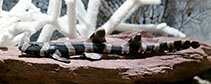
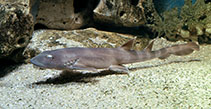
Species: Young with dark transverse bands and usually a scattering of a few dark spots, bars not prominently edged with black (Ref. 13575, 43278). Adults light-brown, usually without a color pattern (Ref. 13575). Dorsal fins larger than pelvic fins, with projecting free rear tips (Ref. 13575). Body without lateral dermal ridge (Ref. 4832,43278, 13575).
Body shape (shape guide): elongated.
A common inshore bottom shark found on coral reefs, often in tide pools (Ref. 247). Probably feeds on bottom invertebrates and small fish (Ref. 6871). Oviparous (Ref. 50449). Can survive up to 12 hours out of water (Ref. 247). Gills sometimes infested by larval isopods (Praniza-larva of isopod Gnathia) (Ref. 247). Utilized as food (Ref. 247); for its meat and fins. Caught frequently by demersal gillnet, longline and trawl fisheries operating in insular and continental shelf waters (Ref.58048).
Life cycle and mating behavior
Kematangan | Reproduksi, perkembang biakan | Pemijahan | telur-telur | Fecundity | Larva
Oviparous, with rounded egg cases (Ref. 247). Paired eggs are laid. Embryos feed solely on yolk (Ref. 50449).
Compagno, L.J.V., 1984. FAO Species Catalogue. Vol. 4. Sharks of the world. An annotated and illustrated catalogue of shark species known to date. Part 1 - Hexanchiformes to Lamniformes. FAO Fish. Synop. 125(4/1):1-249. Rome, FAO. (Ref. 247)
Status IUCN Red List (Ref. 130435: Version 2025-1)
ancaman kepada manusia
Harmless
penggunaan manusia
Perikanan: komersial; Akuarium: Komersial
Alat, peralatan
laporan khas
muat turun XML
Sumber internet
Estimates based on models
Preferred temperature (Acuan
123201): 24.6 - 29.1, mean 28.2 °C (based on 1554 cells).
Phylogenetic diversity index (Acuan
82804): PD
50 = 0.5039 [Uniqueness, from 0.5 = low to 2.0 = high].
Bayesian length-weight: a=0.00398 (0.00176 - 0.00901), b=3.09 (2.89 - 3.29), in cm total length, based on LWR estimates for this (Sub)family-body shape (Ref.
93245).
Trophic level (Acuan
69278): 4.1 ±0.64 se; based on food items.
Daya lenting (Acuan
120179): Rendah, Waktu penggandaan populasi minimum 4.5 - 14 tahun (Fec assumed to be <100).
Fishing Vulnerability (Ref.
59153): Very high vulnerability (79 of 100).
🛈
Nutrients (Ref.
124155): Calcium = 9.48 [1.89, 37.88] mg/100g; Iron = 0.322 [0.077, 0.926] mg/100g; Protein = 19.3 [17.2, 21.5] %; Omega3 = 0.0808 [, ] g/100g; Selenium = 33.3 [10.3, 98.8] μg/100g; VitaminA = 56.4 [16.8, 193.3] μg/100g; Zinc = 0.864 [0.413, 1.781] mg/100g (wet weight);