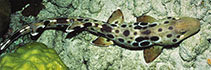
Elasmobranchii (Haie und Rochen) (sharks and rays) >
Orectolobiformes (Carpet sharks) >
Hemiscylliidae (Bamboo sharks)
Etymology: Hemiscyllium: hemi-, from hemisys (Gr.), half, presumably referring to similarity and/ or close affinity to Scyllium (=Scyliorhinus, now in Scyliorhinidae) and/or Chiloscyllium; skylion, Greek for dogfish or small shark (See ETYFish); hallstromi: In honor of philanthropist Edward Hallstrom (1886-1970), trustee and chairman of Taronga Zoological Park (Sydney, Australia), where holotype and paratype were alive in captivity (See ETYFish).
Eponymy: Sir Edward John Lees Hallstrom (1886–1970) was born in Coonamble, New South Wales, Australia. [...] (Ref. 128868), visit book page.
More on author: Whitley.
Environment: milieu / climate zone / Tiefenbereich / distribution range
Ökologie
seewasser riff-verbunden; tiefenbereich 0 - 15 m (Ref. 90102). Tropical; 7°S - 10°S, 144°E - 146°E (Ref. 54464)
Western Pacific: Known only from Papua New Guinea (Gulf of Papua to Milne Bay Prov.). Reported from Indonesia (occurrence questionable).
Size / Gewicht / Alter
Geschlechtsreife: Lm ? range ? - ? cm
Max length : 77.0 cm TL Männchen/unbestimmt; (Ref. 90102)
Rückenflossenstacheln (insgesamt) : 0; Afterflossenstacheln: 0. Caudal fin with a pronounced subterminal notch but without a ventral lobe (Ref. 13575). Lateral ocellus surrounded by large black spots; spots absent from head in front and below eyes (Ref. 13575).
Body shape (shape guide): elongated.
A little-known inshore bottom shark, probably on coral reefs (Ref. 247). Oviparous (Ref. 50449).
Life cycle and mating behavior
Geschlechtsreife | Fortpflanzung | Ablaichen | Eier | Fecundity | Larven
Oviparous, paired eggs are laid. Embryos feed solely on yolk (Ref. 50449).
Compagno, L.J.V., 1984. FAO Species Catalogue. Vol. 4. Sharks of the world. An annotated and illustrated catalogue of shark species known to date. Part 1 - Hexanchiformes to Lamniformes. FAO Fish. Synop. 125(4/1):1-249. Rome, FAO. (Ref. 247)
IUCN Rote Liste Status (Ref. 130435: Version 2025-1)
Bedrohung für Menschen
Harmless
Nutzung durch Menschen
Fischereien: weniger kommerziell
Tools
Zusatzinformationen
Download XML
Internet Quellen
Estimates based on models
Phylogenetic diversity index (Ref.
82804): PD
50 = 0.5020 [Uniqueness, from 0.5 = low to 2.0 = high].
Bayesian length-weight: a=0.00398 (0.00176 - 0.00901), b=3.09 (2.89 - 3.29), in cm total length, based on LWR estimates for this (Sub)family-body shape (Ref.
93245).
Trophic level (Ref.
69278): 3.5 ±0.3 se; based on size and trophs of closest relatives
Widerstandsfähigkeit (Ref.
120179): niedrig, Verdopplung der Population dauert 4,5 - 14 Jahre. (Fec assumed to be <100).
Fishing Vulnerability (Ref.
59153): Moderate to high vulnerability (51 of 100).
🛈