>
Gadiformes (Cods) >
Bregmacerotidae (Codlets)
Etymology: Bregmaceros: Greek, bregma = front of the head + Greek, keras, -atos = horn (Ref. 45335).
Eponymy: Dr Edward D Houde is a fisheries scientist and oceanographer. [...] (Ref. 128868), visit book page.
Issue
Based on juveniles which may represent more than one species, the validity of the species is doubtful (Torii, 2003, unpublished thesis) (H.Ho, pers.comm. 2/2017).
Environment: milieu / climate zone / intervalo de profundidade / distribution range
Ecologia
marinhas pelagic-neritic. Tropical
Western Atlantic: eastern Gulf of Mexico and the Caribbean Sea west of the Lesser Antilles.
Tamanho / Peso / Idade
Maturidade: Lm ? range ? - ? cm
Max length : 1.6 cm SL macho/indeterminado; (Ref. 37039)
Descrição breve
Chaves de identificação | Morfologia | Morfometria
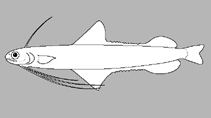
Raios dorsais moles (total) : 40 - 44; Raios anais moles: 41 - 46; Vértebras: 47 - 50. Body color limited to dark melanophores located on anterior half of body. Dorsal and anal fins are relatively short and symmetrical. Snout moderately acute. Terminal mouth with jaws slightly oblique and extends beyond anterior margin of pupil. Head length 21.3-25.5%; predorsal length 25.6-45.2%; body depth 13-16% of SL. Eye diameter 0.7-0.9 times the snout length and 0.9-1.3 times interorbital width. Head length 3.5-5.3 times interorbital width. Caudal fin has31-33 rays. Myomeres 44-47. Smallest larvae (1.7 - 3.5 mm SL) have large, stellate chromatophores at angle of jaw, scattered over hindbrain and at the base of 1st dorsal fin. Large larvae (5-10 mm SL) have additional chromatophores on midbrain, hindbrain, and on ventral surface of anterior half of visceral mass. Juvenile specimens have chromatophores scattered over anterior third of the body (Ref. 37039).
Body shape (shape guide): elongated; Cross section: compressed.
Maximum size given for a juvenile specimen which may be paedomorphic (Ref. 37039).
Life cycle and mating behavior
Maturidade | Reprodução | Desova | Ovos | Fecundidade | Larvas
McEachran, J.D. and J.D. Fechhelm, 1998. Fishes of the Gulf of Mexico. Volume 1: Myxiniformes to Gasterosteiformes. University of Texas Press, Austin. 1112p. (Ref. 37039)
Categoria na Lista Vermelha da IUCN (Ref. 130435: Version 2025-1)
Ameaça para o homem
Harmless
Utilização humana
Ferramentas
Relatórios especiais
Descarregue XML
Fontes da internet
Estimates based on models
Preferred temperature (Ref.
123201): 17.3 - 27.1, mean 22.4 °C (based on 141 cells).
Phylogenetic diversity index (Ref.
82804): PD
50 = 0.5000 [Uniqueness, from 0.5 = low to 2.0 = high].
Bayesian length-weight: a=0.00372 (0.00167 - 0.00826), b=3.17 (2.97 - 3.37), in cm total length, based on LWR estimates for this (Sub)family-body shape (Ref.
93245).
Nível Trófico (Ref.
69278): 3.0 ±0.3 se; based on size and trophs of closest relatives
Fishing Vulnerability (Ref.
59153): Low vulnerability (10 of 100).
🛈