Klassifizierung / Names
Namen | Synonyme | Catalog of Fishes(Gattung, Arten) | ITIS | CoL | WoRMS | Cloffa
>
Gobiiformes (Gobies) >
Gobiidae (Gobies) > Gobiinae
Etymology: Carrigobius: Name from the Latin 'gobius' (goby or gudgeon) and Carrie, referring to Carrie-Bow Cay, Belize, home of the Smithsonian Institution’s field station, where many specimens of Carrigobius amblyrhynchus were collected.
Eponymy: Not an eponym but a toponym referring to Carrie-Bow Cay, Belize, home of the Smithsonian Institution’s field station, where many specimens of C. amblyrhynchus were collected. (Ref. 128868), visit book page.
Environment: milieu / climate zone / Tiefenbereich / distribution range
Ökologie
seewasser demersal; tiefenbereich 8 - 50 m (Ref. 92840). Tropical
Verbreitung
Länder | FAO Gebiete | Ecosystems | Vorkommen | Punkt Karte | Einführungen | Faunafri
Western Central Atlantic: Belize.
Size / Gewicht / Alter
Geschlechtsreife: Lm ? range ? - ? cm
Max length : 4.0 cm SL Männchen/unbestimmt; (Ref. 92840)
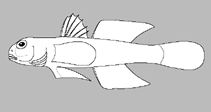
Rückenflossenstacheln (insgesamt) : 8; Rückenflossenweichstrahlen (insgesamt) : 10 - 11; Afterflossenstacheln: 1; Afterflossenweichstrahlen: 8 - 10; Wirbelzahl: 27. This species is distinguished by having all taxonomic characters present in most members of Gobiosomatini and Gobiosoma group (i.e., first dorsal-fin spines VII, pterygiophore insertion pattern of 3-221110, vertebrae 27, precaudal 11 and caudal 16, hypurals 1 and 2 fused to some extent with hypurals 3 and 4 and the terminal vertebral element, 1 epural); pelvic fins are well separated, lacking both the anterior frenum and well-developed membrane
connecting innermost rays (inter-radial membrane better developed in larvae); pelvic-fin rays
1-5, branched (the fifth ray branched only in mature adults), without fleshy or flattened tips; pelvic-fin rays extending posteriorly to about halfway to the anus or slightly further, but never reaching anus; no scales on the body (modified basicaudal scales absent); two anal-fin pterygiophores are inserted before first haemal spine; no cephalic sensory canals; D2 I,10-11; A I,8-10; body with diffuse dark saddles and a series of evenly spaced midlateral blotches on side of body; anterior profile of head blunt and nearly vertical (Ref. 113825).
Body shape (shape guide): elongated; Cross section: oval.
Inhabits sandy bottoms in coral-reef habitats (Ref. 92840).
Life cycle and mating behavior
Geschlechtsreife | Fortpflanzung | Ablaichen | Eier | Fecundity | Larven
Tornabene, L., J.L. Van Tassel, D.R. Robertson and C.C. Baldwin, 2016. Molecular phylogeny, analysis of discrete character evolution, and submersible collections facilitate a new classification for a diverse group of gobies (Teleostei: Gobiidae: Gobiosomatini: Nes subgroup), with descriptions of nine new species. Zoological Journal of the Linnean Society 177(4):764-812. (Ref. 113825)
IUCN Rote Liste Status (Ref. 130435: Version 2025-1)
Bedrohung für Menschen
Harmless
Nutzung durch Menschen
Tools
Zusatzinformationen
Download XML
Internet Quellen
Estimates based on models
Phylogenetic diversity index (Ref.
82804): PD
50 = 1.0000 [Uniqueness, from 0.5 = low to 2.0 = high].
Bayesian length-weight: a=0.00724 (0.00339 - 0.01546), b=3.10 (2.92 - 3.28), in cm total length, based on LWR estimates for this (Sub)family-body shape (Ref.
93245).
Trophic level (Ref.
69278): 3.2 ±0.3 se; based on size and trophs of closest relatives
Widerstandsfähigkeit (Ref.
120179): hoch, Verdopplung der Population dauert weniger als 15 Monate. (Preliminary K or Fecundity.).
Fishing Vulnerability (Ref.
59153): Low vulnerability (10 of 100).
🛈