Elasmobranquios (tiburones y rayas) (sharks and rays) >
Carcharhiniformes (Ground sharks) >
Triakidae (Houndsharks) > Triakinae
Etymology: Mustelus: Latin for weasel, an ancient name for sharks, possibly referring to the pointed snouts, swift movements and/or rapacious feeding behavior of smaller predatory sharks [strictly not tautonymous with Squalus mustelus Linnaeus 1758 since type was designated by the ICZN] (See ETYFish); punctulatus: Diminutive of punctum (L.), spot, i.e., having tiny spots, referring to small black spots often present on body (See ETYFish).
More on author: Risso.
Environment: milieu / climate zone / rango de profundidad / distribution range
Ecología
marino demersal. Subtropical; 45°N - 20°N
Eastern Atlantic: Mediterranean to Western Sahara. Confused with Mustelus mustelus and most data for this species were in part attributable to Mustelus mediterraneus.
Length at first maturity / Tamaño / Peso / Age
Madurez: Lm 95.0, range 60 - 100 cm
Max length : 190 cm TL macho / no sexado; (Ref. ); common length : 120 cm TL macho / no sexado; (Ref. )
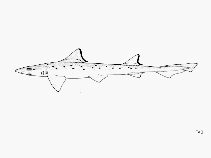
An inshore, continental bottom-dwelling shark. Probably a crustacean feeder. Presumably viviparous.
Life cycle and mating behavior
Madurez | Reproducción | Puesta | Huevos | Fecundidad | Larva
Probably viviparous (Ref. 244). Distinct pairing with embrace (Ref. 205).
Compagno, L.J.V., 1984. FAO Species Catalogue. Vol. 4. Sharks of the world. An annotated and illustrated catalogue of shark species known to date. Part 2 - Carcharhiniformes. FAO Fish. Synop. 125(4/2):251-655. Rome: FAO. (Ref. 244)
IUCN Red List Status (Ref. 130435: Version 2025-1)
Threat to humans
Harmless
Human uses
Pesquerías: comercial
Herramientas
Special reports
Download XML
Fuentes de Internet
Estimates based on models
Preferred temperature (Referencia
123201): 15.3 - 21.6, mean 18.8 °C (based on 182 cells).
Phylogenetic diversity index (Referencia
82804): PD
50 = 0.5000 [Uniqueness, from 0.5 = low to 2.0 = high].
Bayesian length-weight: a=0.00355 (0.00223 - 0.00565), b=3.16 (3.03 - 3.29), in cm total length, based on LWR estimates for this species & Genus-body shape (Ref.
93245).
Nivel trófico (Referencia
69278): 3.8 ±0.4 se; based on diet studies.
Generation time: 3.3 ( na - na) years. Estimated as median ln(3)/K based on 1
growth studies.
Resiliencia (Referencia
120179): Bajo, población duplicada en un tiempo mínimo de 4.5-14 años (tm=1.3-2.6(?); Fecundity is presumably low like other Mustelus species).
Fishing Vulnerability (Ref.
59153): Moderate to high vulnerability (51 of 100).
🛈
Nutrients (Ref.
124155): Calcium = 15.9 [4.3, 80.9] mg/100g; Iron = 0.485 [0.153, 1.866] mg/100g; Protein = 22.1 [19.7, 24.4] %; Omega3 = 0.144 [0.057, 0.357] g/100g; Selenium = 54.4 [14.4, 196.5] μg/100g; VitaminA = 3.8 [1.2, 12.1] μg/100g; Zinc = 0.461 [0.202, 0.945] mg/100g (wet weight);