Ikan bertulang rawan (sharks and rays) >
Carcharhiniformes (Ground sharks) >
Triakidae (Houndsharks) > Triakinae
Etymology: Mustelus: Latin for weasel, an ancient name for sharks, possibly referring to the pointed snouts, swift movements and/or rapacious feeding behavior of smaller predatory sharks [strictly not tautonymous with Squalus mustelus Linnaeus 1758 since type was designated by the ICZN] (See ETYFish); fasciatus: Latin for banded, referring to vertical dark bars on body (at least in young) (See ETYFish).
More on author: Garman.
Environment: milieu / climate zone / kisaran kedalaman / distribution range
Ekologi
laut dasar (demersal); kisaran kedalaman 1 - 250 m (Ref. 56500), usually 1 - 50 m (Ref. 56500). Subtropical; 30°S - 47°S
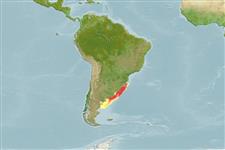
Southwest Atlantic: southern Brazil to northern Argentina.
Length at first maturity / Size / Weight / umur
Kematangan: Lm 123.3 range ? - ? cm
Max length : 150 cm TL jantan/; (Ref. 244); common length : 70.0 cm TL jantan/; (Ref. 6077)
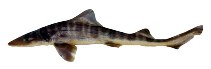
Longer snout relative to the size of the eye, head more flattened. Back brown with narrow transverse bands of darker separated spaces. Yellow spot in front of each eye above each orbit. Fins dark with narrow edgings lighter. Lower surfaces whitish (Ref. 6032).
Body shape (shape guide): elongated.
Found on the continental shelf. Newbies are found on beaches of between 1 and 5 m depth, juveniles occupy inshore waters at between 15 and 50 m, and adults are found down to 50 and on upper slopes of up to 250 m in depth (Ref. 56500). Presumably feeds on crustaceans and other benthic invertebrates. Ovoviviparous, embryos feed solely on yolk (Ref. 50449). Size at birth at or below about 39 cm. Utilized fresh-frozen and dried salted for human consumption.
Ovoviviparous, embryos feed solely on yolk (Ref. 50449). Distinct pairing with embrace (Ref. 205). Migrate to the shore to give birth at the shortest time possible (Ref. 56500).
Compagno, L.J.V., 1984. FAO Species Catalogue. Vol. 4. Sharks of the world. An annotated and illustrated catalogue of shark species known to date. Part 2 - Carcharhiniformes. FAO Fish. Synop. 125(4/2):251-655. Rome: FAO. (Ref. 244)
Status IUCN Red List (Ref. 130435: Version 2025-1)
ancaman kepada manusia
Harmless
penggunaan manusia
Perikanan: komersial
Alat, peralatan
laporan khas
muat turun XML
Sumber internet
Estimates based on models
Preferred temperature (Acuan
123201): 10.5 - 18, mean 14.5 °C (based on 166 cells).
Phylogenetic diversity index (Acuan
82804): PD
50 = 0.5000 [Uniqueness, from 0.5 = low to 2.0 = high].
Bayesian length-weight: a=0.00224 (0.00104 - 0.00482), b=3.14 (2.97 - 3.31), in cm total length, based on LWR estimates for this Genus-body shape (Ref.
93245).
Trophic level (Acuan
69278): 4.2 ±0.7 se; based on diet studies.
Daya lenting (Acuan
120179): sangat rendah, Waktu penggandaan populasi minimum lebih dari 14 tahun (Fec = 4).
Fishing Vulnerability (Ref.
59153): Very high vulnerability (90 of 100).
🛈