>
Anguilliformes (Eels and morays) >
Nemichthyidae (Snipe eels)
Etymology: Nemichthys: Greek, nema, -atos = filament + Greek, ichthys = fish (Ref. 45335); larseni: Named for Verner Larsen, who began the study of this species while at the University of Copenhagen.
Eponymy: Verner Larsen is a Danish ichthyologist, who began revising Nemichthys whilst still a student at the University of Copenhagen, and who, according to the etymology, “…generously handed over his material” to the authors “…when he was unable to finish [...] (Ref. 128868), visit book page.
More on authors: Nielsen & Smith.
Environment: milieu / Zona climática / intervalo de profundidade / distribution range
Ecologia
marinhas batipelágico; intervalo de profundidade 170 - 1280 m (Ref. 96339). Deep-water; 47°N - 17°N, 170°E - 105°W
Eastern Pacific: Oregon, USA to central Mexico, including the Gulf of California; also Hawaii and north of Hawaii to about 38°N.
Tamanho / Peso / Idade
Maturidade: Lm ? range ? - ? cm
Max length : 161 cm TL macho/indeterminado; (Ref. 40789)
Descrição suscinta
Chaves de identificação | Morfologia | Morfometria
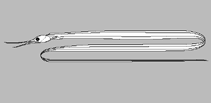
Raios dorsais (total) : 173 - 222; Raios anais : 164 - 208. Most easily distinguished from N. scolopaceus by its pale color; has more postorbital and preopercular pores. Rectangle formed by the lateral line pores is shorter and higher than in scolopaceus. Resembles N. curvirostris in its pale color but the subcutaneous dark bars are not as evident. May be instantly distinguished from curvirostris by the more numerous postorbital and preopercular pores and the much shorter and higher rectangle formed by the lateral line pores. Has smaller teeth than curvirostris.
Body shape (shape guide): eel-like.
Mesopelagic (Ref. 58302). Minimum depth from Ref. 58018.
Ciclo de vida ou comportamento de acasalamento
Maturidade | Reprodução | Desova | Ovos | Fecundidade | Larvas
Nielsen, J.G. and D.G. Smith, 1978. The eel family Nemichthyidae (Pisces, Anguilliformes). Carlsberg Found., Dana-Rept. No. 88:71 p. (Ref. 7450)
Status na Lista Vermelha da UICN (Ref. 130435: Version 2025-1)
Ameaça para os humanos
Harmless
Uso pelos humanos
Ferramentas
Relatórios especiais
Baixar XML
Fontes da internet
Estimates based on models
Preferred temperature (Ref.
123201): 6.8 - 7.9, mean 7.4 °C (based on 6 cells).
Índice de diversidade filogenética (Ref.
82804): PD
50 = 0.6270 [Uniqueness, from 0.5 = low to 2.0 = high].
Bayesian length-weight: a=0.00102 (0.00046 - 0.00225), b=3.06 (2.88 - 3.24), in cm total length, based on all LWR estimates for this body shape (Ref.
93245).
Nível Trófico (Ref.
69278): 3.5 ±0.5 se; based on size and trophs of closest relatives
Resiliência (Ref.
120179): Baixo, tempo mínimo de duplicação da população 4,5 - 14 anos (Assuming tmax>10).
Fishing Vulnerability (Ref.
59153): Very high vulnerability (90 of 100).
🛈