Klassifizierung / Names
Namen | Synonyme | Catalog of Fishes(Gattung, Arten) | ITIS | CoL | WoRMS | Cloffa
>
Acropomatiformes (Oceanic basses) >
Creediidae (Sandburrowers)
Etymology: Creedia: Greek, kreesi, kreas = somebody that receives or keeps flesh (Ref. 45335); bilineata: Named in reference to the two stripes on the body.
Eponymy: John Mildred Creed (1842–1930), a friend of Ogilby’s, was an English-born Australian physician and politician. [...] (Ref. 128868), visit book page.
Environment: milieu / climate zone / Tiefenbereich / distribution range
Ökologie
seewasser demersal; tiefenbereich 3 - 5 m (Ref. 12706). Subtropical
Northwest Pacific: endemic of Ryukyu Is. (Ref.. 12706).
Size / Gewicht / Alter
Geschlechtsreife: Lm ? range ? - ? cm
Max length : 3.2 cm SL Männchen/unbestimmt; (Ref. 12706)
Kurzbeschreibung
Bestimmungsschlüssel | Morphologie | Morphometrie
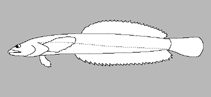
Rückenflossenweichstrahlen (insgesamt) : 15 - 16; Afterflossenweichstrahlen: 17 - 18; Wirbelzahl: 42. Epurals 2; body with two yellowish brown stripes in life (Ref. 12706).
Body shape (shape guide): eel-like.
Found on shallow sandy bottom (Ref. 12706). Observed to abruptly rush out of the sand and immediately dive into nearby when disturbed (Ref. 12706).
Life cycle and mating behavior
Geschlechtsreife | Fortpflanzung | Ablaichen | Eier | Fecundity | Larven
Shimada, K. and T. Yoshino, 1987. A new creediid fish Creedia bilineatus from the Yaeyama Islands, Japan. Jap. J. Ichthyol. 34(2):123-127. (Ref. 12706)
IUCN Rote Liste Status (Ref. 130435: Version 2025-1)
Bedrohung für Menschen
Harmless
Nutzung durch Menschen
Tools
Zusatzinformationen
Download XML
Internet Quellen
Estimates based on models
Preferred temperature (Ref.
123201): 20.5 - 26.3, mean 23.5 °C (based on 109 cells).
Phylogenetic diversity index (Ref.
82804): PD
50 = 0.5625 [Uniqueness, from 0.5 = low to 2.0 = high].
Bayesian length-weight: a=0.00102 (0.00046 - 0.00225), b=3.06 (2.88 - 3.24), in cm total length, based on all LWR estimates for this body shape (Ref.
93245).
Trophic level (Ref.
69278): 3.1 ±0.4 se; based on size and trophs of closest relatives
Fishing Vulnerability (Ref.
59153): Low vulnerability (10 of 100).
🛈