>
Eupercaria/misc (Various families in series Eupercaria) >
Gerreidae (Mojarras)
Etymology: Gerres: Latin, gerres = a kind of anchovies; cited by Plinius; microphthalmus: Named for its small eyes (small in diameter).
Environment: milieu / climate zone / rango de profundidad / distribution range
Ecología
marino; salobre pelagic-neritic; rango de profundidad ? - 20 m (Ref. 58018). Temperate; ? - 16°C (Ref. 43141)
Northwest Pacific: southern Japan.
Tamaño / Peso / Age
Madurez: Lm ? range ? - ? cm
Max length : 12.0 cm SL macho / no sexado; (Ref. 43141)
Short description
Claves de identificación | Morfología | Morfometría
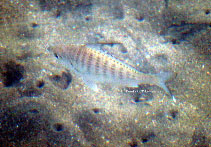
Espinas dorsales (total) : 9; Radios blandos dorsales (total) : 10; Espinas anales: 3; Radios blandos anales: 7. Second dorsal fin elongated, reaching just short of last dorsal fin ray when depressed (in all stages, up to 50% SL, mean 42% SL, tip very easily broken). Orbit diameter relatively small (8-11% SL), ratio as % of snout length, 93-143. Head length relatively short, 30-33% of SL. Maxillary reaching to below or (rarely) just short of anterior margin of iris. Exposed maxillary process always tapering to a point anteriorly for about half its length. Supraneural bones 3 (Ref. 43141).
Body shape (shape guide): short and / or deep; Cross section: compressed.
Life cycle and mating behavior
Madurez | Reproducción | Puesta | Huevos | Fecundidad | Larva
Iwatsuki, Y., S. Kimura and T. Yoshino, 2002. A new species: Gerres microphthalmus (Perciformes: Gerreidae) from Japan with notes on limited distribution, included in the G. filamentosus complex. Ichthyol. Res. 49(2):133-139. (Ref. 43141)
IUCN Red List Status (Ref. 130435: Version 2025-1)
Threat to humans
Harmless
Human uses
Herramientas
Special reports
Download XML
Fuentes de Internet
Estimates based on models
Phylogenetic diversity index (Referencia
82804): PD
50 = 0.5000 [Uniqueness, from 0.5 = low to 2.0 = high].
Bayesian length-weight: a=0.01413 (0.00599 - 0.03330), b=3.04 (2.86 - 3.22), in cm total length, based on LWR estimates for this Genus-body shape (Ref.
93245).
Nivel trófico (Referencia
69278): 3.3 ±0.3 se; based on size and trophs of closest relatives
Resiliencia (Referencia
120179): Alto, población duplicada en un tiempo mínimo inferior a 15 meses (Preliminary K or Fecundity.).
Fishing Vulnerability (Ref.
59153): Low vulnerability (10 of 100).
🛈