>
Mulliformes (Goatfishes) >
Mullidae (Goatfishes)
Etymology: Parupeneus: Latin, parum, parvum = small + Peneus, the name of a river.
More on author: Lacepède.
Issue
FishBase common name changed from Whitesaddle goatfish to Blacksaddle goatfish (Uiblein et al., 2024: Ref. 130857). Whitesaddle goatfish is now used for Parupeneus porphyreus.
Environment: milieu / climate zone / intervalo de profundidade / distribution range
Ecologia
marinhas associadas(os) a recifes; intervalo de profundidade 2 - 91 m (Ref. 26165), usually 2 - 40 m (Ref. 37816). Tropical; 30°N - 30°S
Indo-Pacific: western Indian Ocean to the Line, Marquesan, and Tuamoto islands, north to southern Japan, south to Australia and Rapa. Replaced by Parupeneus porphyreus in the Hawaiian Islands (Ref. 37816).
Tamanho / Peso / Idade
Maturidade: Lm ? range ? - ? cm
Max length : 38.0 cm TL macho/indeterminado; (Ref. 9710); peso máx. Publicado: 2.3 kg (Ref. 4887)
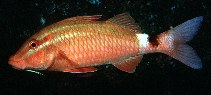
Espinhos dorsais (total) : 8; Raios dorsais moles (total) : 9; Espinhos anais: 1; Raios anais moles: 7. Diagnosis: Pectoral rays 15 (rarely 14 or 16); gill rakers 6-8 + 23-27 (total 30-34); body depth 2.93.5 in SL; head length (HL) 2.85-3.25 in SL; dorsal profile of snout straight to slightly concave, the snout length 1.85-2.1 in HL; barbels short, 1.5-1.8 in HL; longest dorsal spine 1.55-1.9 in HL; last dorsal ray slightly longer than penultimate ray; posterior margin of caudal-fin lobes convex; pectoral-fin length 1.35-1.55 in HL; pelvic-fin length 1.2-1.55 in HL. Color brown to red dorsally, paler ventrally, the scale edges darker; scales on body with or without a white or pale blue spot; a darker brown or brownish red stripe, broadly bordered in white, from front of snout through center of eye, becoming indistinct below origin of second dorsal fin; a dark brown spot within stripe behind eye; a second dark stripe across cheek parallel to the first, bordered below by a white band that ends at pectoral-fin base; a white or pale pink spot anteriorly on upper half of caudal peduncle covering about three horizontal rows of scales, followed by a black or dusky spot with darker scale edges a little larger in size (spot may extend slightly below lateral line); fins light red to reddish gray, the second dorsal and anal fins often with small pale spots (Ref. 54393).
Body shape (shape guide): fusiform / normal; Cross section: circular.
Occurs in seagrass beds and coralline areas of lagoon and seaward reefs. Feeds on benthic invertebrates, mostly crustaceans, at night.
Life cycle and mating behavior
Maturidade | Reprodução | Desova | Ovos | Fecundidade | Larvas
Randall, J.E., 2004. Revision of the goatfish genus Parupeneus (Perciformes: Mullidae), with descriptions of two new species. Indo-Pac. Fish. (36):64 p. (Ref. 54393)
Categoria na Lista Vermelha da IUCN (Ref. 130435: Version 2025-1)
Ameaça para o homem
Harmless
Utilização humana
Pescarias: espécies comerciais; peixe desportivo: sim
Ferramentas
Relatórios especiais
Descarregue XML
Fontes da internet
Estimates based on models
Preferred temperature (Ref.
123201): 24.3 - 28.9, mean 27.6 °C (based on 1374 cells).
Phylogenetic diversity index (Ref.
82804): PD
50 = 0.5000 [Uniqueness, from 0.5 = low to 2.0 = high].
Bayesian length-weight: a=0.01096 (0.00699 - 0.01721), b=3.13 (3.00 - 3.26), in cm total length, based on LWR estimates for this species & Genus-body shape (Ref.
93245).
Nível Trófico (Ref.
69278): 3.5 ±0.0 se; based on diet studies.
Resiliência (Ref.
120179): Médio, tempo mínimo de duplicação da população 1,4 - 4,4 anos (Preliminary K or Fecundity.).
Fishing Vulnerability (Ref.
59153): Low to moderate vulnerability (28 of 100).
🛈
Nutrients (Ref.
124155): Calcium = 30.8 [15.8, 68.0] mg/100g; Iron = 0.299 [0.152, 0.660] mg/100g; Protein = 17.9 [14.5, 20.9] %; Omega3 = 0.127 [0.073, 0.231] g/100g; Selenium = 58.4 [28.6, 132.5] μg/100g; VitaminA = 190 [39, 787] μg/100g; Zinc = 0.52 [0.31, 0.99] mg/100g (wet weight);