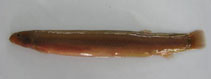
Environment: milieu / climate zone / εύρος βάθους / distribution range
Οικολογία
; Γλυκού νερού βενθικό(ς). Tropical
Asia: India, Bangladesh, Myanmar.
Μέγεθος / Βάρος / Age
Γεννητική Ωρίμανση: Lm ? range ? - ? cm
Max length : 6.5 cm TL αρσενικό/απροσδιόριστο; (Ref. 85009)
Short description
Κλείδες προσδιορισμού | Μορφολογία | Μορφομετρία
Μαλακές ραχιαίες ακτίνες (συνολικά) : 10; Μαλακές εδρικές ακτίνες: 9; Σπόνδυλοι: 47 - 52. Differs from members of the P. kuhlii and P. shelfordii groups and the Myanmar P. signicauda and P. lumbriciformis by having plain brown color pattern. Distinguished from species of the P. anguillaris group and P. signicauda and P. lumbriciformis by possessing fewer abdominal vertebrae (34-39 vs 40-52). Differs from the other members of the P. oblonga group by the following characters: from P. filinaris and P. mariarum by the absence of the nasal barbel (vs presence) and from P. oblonga by a narrower body (7.6-9 times SL vs 7.2-7.7). Can be differentiated from all other Myanmar species by the longer pectoral fins (8.2-9.6 % SL vs 5.3-7.0), and further from P. elongata, P. lumbriciformis and P. signicauda by a deeper body (body depth 13.5-16.3 % SL vs 6.5-9.3) and a deeper (caudal peduncle depth 7.5-9.7 % SL vs 4.1-5.5 % SL) and shorter caudal peduncle (caudal peduncle length 10.5-12.5 % SL vs 14.9-16.6 % SL), from P. fusca and P. apoda by presence of the pelvic girdle and pelvic fins (vs absence), from P.signicauda and P. lumbriciformis by the plain brown coloration (vs with dark marks on body and fins), from P. fusca by the number of abdominal vertebrae (34-39 vs 41-44) and the absence of a nasal barbel (vs presence), and from P. elongata by relatively more posteriorly placed pelvic fins (prepelvic length 79-86.8 % SL vs 56.3 % SL) (Ref. 57993).
Body shape (shape guide): elongated.
Facultative air-breathing in the genus (Ref. 126274); Inhabits slow moving rivers with sandy bottom (Ref. 41236).
Life cycle and mating behavior
Γεννητική Ωρίμανση | Αναπαραγωγή | Γεννοβολία | Αβγά | Γονιμότητα | Προνύμφες
Menon, A.G.K., 1999. Check list - fresh water fishes of India. Rec. Zool. Surv. India, Misc. Publ., Occas. Pap. No. 175, 366 p. (Ref. 41236)
IUCN Red List Status (Ref. 130435: Version 2025-1)
Threat to humans
Harmless
Human uses
αλιεία: χωρίς ενδιαφέρον
Εργαλεία
Special reports
Download XML
Διαδικτυακές πηγές
Estimates based on models
Phylogenetic diversity index (Αναφ.
82804): PD
50 = 0.5000 [Uniqueness, from 0.5 = low to 2.0 = high].
Bayesian length-weight: a=0.00347 (0.00184 - 0.00652), b=2.99 (2.83 - 3.15), in cm total length, based on LWR estimates for this species & (Sub)family-body (Ref.
93245).
Τροφικό Επίπεδο (Αναφ.
69278): 3.4 ±0.4 se; based on size and trophs of closest relatives
Ελαστικότητα (Αναφ.
120179): Υψηλό, ελάχιστος χρόνος για διπλασιασμό πληθυσμού < 15 μήνες (Preliminary K or Fecundity.).
Fishing Vulnerability (Ref.
59153): Low vulnerability (10 of 100).
🛈