



Pseudobalistes flavimarginatus (Rüppell, 1829)
Yellowmargin triggerfish
Beobachtung melden im Fish Watcher
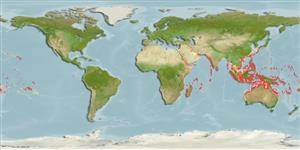
| Native range | All suitable habitat | Point map | Year 2050 |
|
| This map was computer-generated and has not yet been reviewed. |
| Pseudobalistes flavimarginatus AquaMaps Data sources: GBIF OBIS |
Hochladen Photos und videos
Bilder | videos | Google Bild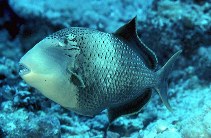 Pseudobalistes flavimarginatus
Photo von Randall, J.E.
Bilder | videos | Google Bild
Photo von Randall, J.E.
Klassifizierung / Names Namen | Synonyme | Catalog of Fishes(Gattung, Arten) | ITIS | CoL | WoRMS | Cloffa
> Tetraodontiformes (Puffers and filefishes) > Balistidae (Triggerfishes)
Etymology: Pseudobalistes: Greek, pseudes = false + Greek, ballo = to throw (Ref. 45335).
More on author: Rüppell.
Etymology: Pseudobalistes: Greek, pseudes = false + Greek, ballo = to throw (Ref. 45335).
More on author: Rüppell.
Umwelt: Milieu / Klimazone / Tiefenbereich / Verbreitungsgebiet Ökologie
seewasser; brackwasser riff-verbunden; tiefenbereich 2 - 80 m (Ref. 1602). Tropical; 22°C - 27°C (Ref. 130614); 34°N - 34°S, 27°E - 124°W
Verbreitung Territorien | FAO Gebiete | Ökosysteme | Vorkommen | Punkt Karte | Einführungen | Faunafri
Indo-Pacific: Red Sea to East Africa eastward through northern Australia reaching Tuamotu Islands, north to southern Japan.
Größe / Gewicht / Alter
Kurzbeschreibung Bestimmungsschlüssel | Morphologie | Morphometrie
Rückenflossenstacheln (insgesamt) : 3; Rückenflossenweichstrahlen (insgesamt) : 24 - 27; Afterflossenstacheln: 0; Afterflossenweichstrahlen: 22 - 25. Scales relatively large (Ref. 9002).
Body shape (shape guide): short and / or deep.
Body shape (shape guide): short and / or deep.
Inhabits coastal to inner reefs and estuaries, often in silty habitats (Ref. 48637). Found on lagoon slope and floor (Ref. 30573), also coral reefs. Generally solitary or in pairs (Ref. 4420). Young form small aggregations when common while adults are usually seen solitary, except when nesting and males congregate on certain sand flats adjacent to reefs (Ref. 48637). Feeds on tips of coral branches, gastropods, crustaceans, foraminiferans, and tunicates (Ref. 1602) and also on sea urchins (Ref. 9770). Oviparous (Ref. 205). Nest-guarding females are aggressive (Ref. 9770). Also caught with drive-in nets. Marketed fresh and dried-salted (Ref. 9770). Ciguatoxic in certain areas (Ref. 37816). Maximum depth reported taken from Ref. 128797.
Lebenszyklus und Paarungsverhalten Geschlechtsreife | Fortpflanzung | Ablaichen | Eier | Fruchtbarkeit | Larven
Males migrate to a traditional spawning ground where they establish territories enclosing nest sites and egg chambers (Ref. 9777). Nesting occurs in sand-bottomed channels and shallow cuts through the barrier reef (Ref. 9778, 37816). The nest consist of depressions up to 2 m wide and 0.7 m deep (Ref. 9778, 37816). Females arrive several days later and select a male for mating (Ref. 9777). Exhibit biparental care (Ref. 9777). Up to 430,000 or more eggs may be deposited in a spongy fist-sized cluster weighted down with pieces of rubble (Ref. 9778, 37816). Males establish a territory for spawning and parental care but not for feeding (Ref. 116451). Only females tend the eggs but both parents keep guard (Ref. 116451).
Hauptreferenz
Laden Sie Ihre Referenzen hoch | Referenzen | Koordinator : Matsuura, Keiichi | Partner
Myers, R.F., 1991. Micronesian reef fishes. Second Ed. Coral Graphics, Barrigada, Guam. 298 p. (Ref. 1602)
IUCN Rote Liste Status (Ref. 130435: Version 2025-2 (Global))
nicht bedroht (LC) ; Date assessed: 13 January 2022
CITES
Not Evaluated
Bedrohung für Menschen
Reports of ciguatera poisoning (Ref. 1602)
Nutzung durch Menschen
Fischereien: kommerziell; Aquarium: Kommerziell
FAO - Publication: search | FishSource | Das Meer um uns herum
Mehr Information
Trophische Ökologie
Lebensmittel (Beutetiere)
Nahrungszusammensetzung
Nahrungsaufnahme
Lebensmittelrationen
Räuber
Lebensmittel (Beutetiere)
Nahrungszusammensetzung
Nahrungsaufnahme
Lebensmittelrationen
Räuber
Populationsdynamik
Wachstumsparameter
Max. Alter/Größen
Länge-Gewicht-Rel.
Länge-Länge-Verhältnis.
Längenhäufigkeiten
Massenkonvertierung
Rekrutierung
Dichte
Wachstumsparameter
Max. Alter/Größen
Länge-Gewicht-Rel.
Länge-Länge-Verhältnis.
Längenhäufigkeiten
Massenkonvertierung
Rekrutierung
Dichte
Lebenszyklus
Fortpflanzung
Geschlechtsreife
Reifung/Kiemen rel.
Fruchtbarkeit
Ablaichen
Laichaggregationen
Eier
Eientwicklung
Larven
Larven Pop.Dyn.
Fortpflanzung
Geschlechtsreife
Reifung/Kiemen rel.
Fruchtbarkeit
Ablaichen
Laichaggregationen
Eier
Eientwicklung
Larven
Larven Pop.Dyn.
Anatomie
Kiemenoberfläche
Gehirn
Otolith
Kiemenoberfläche
Gehirn
Otolith
Physiologie
Körperliche Zusammensetzung
Nährstoffe
Sauerstoffverbrauch
Schwimmart
Schwimmgeschwindigkeit
Visuelle Pigmente
Fischgeräusche
Krankheiten und Parasiten
Toxizität (LC50s)
Körperliche Zusammensetzung
Nährstoffe
Sauerstoffverbrauch
Schwimmart
Schwimmgeschwindigkeit
Visuelle Pigmente
Fischgeräusche
Krankheiten und Parasiten
Toxizität (LC50s)
Menschenbezogen
Aquakultur-Systeme
Aquakultur Profile
Zuchtlinien
Ciguatera-Fälle
Briefmarken, Münzen, Verschiedenes.
Aquakultur-Systeme
Aquakultur Profile
Zuchtlinien
Ciguatera-Fälle
Briefmarken, Münzen, Verschiedenes.
Tools
Bio-Quiz | E-Book | Feldführer | Bestimmungsschlüssel | Längenhäufigkeits Tool | Lebensdaten Tool | Punkt Karte |
Catch-MSY |
Zusatzinformationen
Download XML
Zusammenfassung | Punktdaten | Namen | Photos
Internet Quellen
AFORO (otoliths) | Aquatic Commons | BHL | Cloffa | Websites from users | FishWatcher Einträge suchen | CISTI | Catalog of Fishes: Gattung, Arten | DiscoverLife | DORIS | ECOTOX | FAO - Publication: search | Faunafri | Fishipedia | Fishtrace | GloBI | Google Books | Google Scholar | Google | IGFA World Record | Nationale Datenbanken | OneZoom | Open Tree of Life | Otolith Atlas of Taiwan Fishes | PubMed | Reef Life Survey | Socotra Atlas | TreeBase | Tree of Life | Wikipedia: Gehe zu, Suchen | World Records Freshwater Fishing | Zoologischer Rekord
Schätzungen auf der Grundlage von Modellen
|
Phylogenetischer Diversitätsindex (Ref. 82804) |
PD50 = 0.6250 [Uniqueness, from 0.5 = low to 2.0 = high]. |
| Bayesian length-weight | a=0.02692 (0.01290 - 0.05617), b=2.91 (2.73 - 3.09), in cm total length, based on LWR estimates for this (Sub)family-body shape (Ref. 93245). |
|
Trophische Ebene (Ref. 69278) |
2.8 ±0.26 se; based on food items. |
| Generation time | 2.2 ( na - na) years. Estimated as median ln(3)/K based on 1 growth studies. |
|
Widerstandsfähigkeit (Ref. 120179) |
hoch, Verdopplung der Population dauert weniger als 15 Monate. (K=0.49; Fec=430,000). |
|
Anfälligkeit der Fischerei (Ref. 59153) |
Low to moderate vulnerability (29 of 100). 🛈 |
|
Preiskategorie (Ref. 80766) |
Medium. |
|
Nährstoffe (Ref. 124155) |
Calcium = 35.3 [15.1, 84.0] mg/100g; Iron = 0.604 [0.319, 1.321] mg/100g; Protein = 18.7 [16.6, 20.9] %; Omega3 = 0.11 [0.05, 0.22] g/100g; Selenium = 42.7 [20.7, 96.5] μg/100g; VitaminA = 26.4 [6.7, 99.7] μg/100g; Zinc = 1.13 [0.75, 1.74] mg/100g (wet weight); |