Catesbya pseudomuraena

You can sponsor this page

Catesbya pseudomuraena Böhlke & Smith, 1968

Upload your photos and videos
Google image
Image of Catesbya pseudomuraena
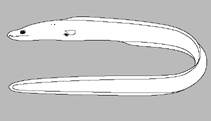
No image available for this species;
drawing shows typical species in Chlopsidae.

Classification / Names आम नाम | उपशब्द | Catalog of Fishes(वर्ग, प्रजाति) | ITIS | CoL | WoRMS | Cloffa

> Anguilliformes (Eels and morays) > Chlopsidae (False morays)
Etymology: Catesbya: Named for Mark Catesby, 1683-1749, studied the fishes from Bahamas,Florida and Caroline (Ref. 45335)pseudomuraena: pseudomuraena to describe the overall appearance of the fish (Ref. 40885).
Eponymy: Mark Catesby (1683–1749) was an English naturalist, artist and traveller. [...] (Ref. 128868), visit book page.

Environment: milieu / climate zone / गहराई सीमा / distribution range पारिस्थितिकी

समुद्री प्रवाल-भित्ति संयुक्त; गहराई सीमा ? - 9 m (Ref. 40885). Tropical

वितरण देश | ऐफ ऐ ओ क्षेत्र | Ecosystems | संयोग | बिन्दु नक्शा | भूमिका | Faunafri

Western Central Atlantic: Bahamas.

आकार / वज़न / Age

परिपक्व अवधि: Lm ?  range ? - ? cm
Max length : 14.0 cm TL पुल्लिंग / अलिंग; (Ref. 40885)

Short description पहचान कुंजी | आकृति विज्ञान | मौरफोमैटरिक्स

जानवरों की रीड़ का जोड़: 141.
Body shape (shape guide): eel-like.

जीवविज्ञान     शब्द संग्रह (उदाहरणार्थ epibenthic)

Collected from a small patch of reef surrounded by sand (Ref. 40885).

Life cycle and mating behavior परिपक्व अवधि | पुनरुत्पत्ति | मछलीऔ का अंडे देना | अंडे | Fecundity | लार्वा

Main reference Upload your references | संदर्भ | संयोजक | सहयोगीयो

Böhlke, J.E. and D.G. Smith, 1968. A new xenocongrid eel from the Bahamas, with notes on other species in the family. Proc. Acad. Nat. Sci. Philad. 120(2):25-43. (Ref. 40885)

IUCN Red List Status (Ref. 130435: Version 2025-1)

  Data deficient (DD) ; Date assessed: 15 August 2011

CITES

Not Evaluated

CMS (Ref. 116361)

Not Evaluated

Threat to humans

  Harmless


Human uses

FAO - Publication: search | FishSource |

अधिक जानकारी

Trophic ecology
Food items (preys)
संघटक आहार
आहार खपत
Food rations
परभक्षी
पारिस्थितिकी
पारिस्थितिकी
Home ranges
Population dynamics
Growth parameters
Max. ages / sizes
Length-weight rel.
Length-length rel.
Length-frequencies
Mass conversion
भर्ती
बहुतायत
Life cycle
पुनरुत्पत्ति
परिपक्व अवधि
Maturity/Gills rel.
Fecundity
मछलीऔ का अंडे देना
Spawning aggregations
अंडे
Egg development
लार्वा
लारवल गतिकी
वितरण
देश
ऐफ ऐ ओ क्षेत्र
Ecosystems
संयोग
भूमिका
BRUVS - Videos
Anatomy
गिल क्षेत्र
Brain
Otolith
Physiology
Body composition
Nutrients
Oxygen consumption
Swimming type
Swimming speed
Visual pigments
Fish sound
Diseases & Parasites
Toxicity (LC50s)
आनुवंशिकी
Genome
आनुवंशिकी
Heterozygosity
हैरेटिबिलटी
Human related
Aquaculture systems
जलीयकृषि रूपरेखाऐ
खींच
Ciguatera cases
Stamps, coins, misc.
संदर्भ
संदर्भ

साधन

Special reports

Download XML

इंटरनेट स्रोत

AFORO (otoliths) | Aquatic Commons | BHL | Cloffa | Websites from users | Check FishWatcher | CISTI | Catalog of Fishes: वर्ग, प्रजाति | DiscoverLife | ECOTOX | FAO - Publication: search | Faunafri | Fishipedia | Fishtrace | GloBI | Google Books | Google Scholar | Google | IGFA World Record | OneZoom | Open Tree of Life | Otolith Atlas of Taiwan Fishes | PubMed | Reef Life Survey | Socotra Atlas | TreeBase | Tree of Life | Wikipedia: Go, खोज | Zoobank | Zoological Record

Estimates based on models

Phylogenetic diversity index (संदर्भ 82804):  PD50 = 1.0000   [Uniqueness, from 0.5 = low to 2.0 = high].
Bayesian length-weight: a=0.00102 (0.00046 - 0.00225), b=3.06 (2.88 - 3.24), in cm total length, based on all LWR estimates for this body shape (Ref. 93245).
Trophic level (संदर्भ 69278):  3.7   ±0.6 se; based on size and trophs of closest relatives
Fishing Vulnerability (Ref. 59153):  Low vulnerability (10 of 100). 🛈