>
Lophiiformes (Anglerfishes) >
Oneirodidae (Dreamers)
Etymology: Puck: From the Germanic folklore, a minor order of mischievous devils, sprites, goblins, and demons; a devilish trickster (Ref. 86949).
Eponymy: Puck is a fairy in the service of Oberon (see Shakespeare’s: A Midsummers Night’s Dream), one of three Shakespearean names coined in the same paper (see O. [...] (Ref. 128868), visit book page.
Environment: milieu / Klimaatzone / Diepte / distribution range
Ecologie
marien bathypelagisch; diepte 1464 - 4073 m (Ref. 86949). Deep-water
Northwest Pacific: known from the type locality, 38°16'N, 152°34'E and Galapagos Islands (Ref. 86949).
Grootte / Gewicht / Leeftijd
Maturiteit: Lm ? range ? - ? cm
Max length : 8.1 cm SL mannelijk / geslacht onbekend; (Ref. 86949)
Korte beschrijving
Determinatiesleutels | Morfologie | Morfometrie
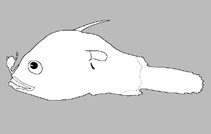
Dorsale zachte stralen (totaal) : 5; Anale zachte stralen: 4. Metamorphosed females distinguished by the following characteristics: wide ethmoid cartilage and vomer, wider than distance between anterolateral tips of lateral ethmoids and frontals; presence of vomerine teeth; nasal foramina large and oval in shape; short frontals, lying posterior to the ethmoid region, strongly convex dorsal margin; ventromedial extensions of frontals approach each other on midline, making contact with parasphenoid; frontals separated from prootics; presence of pterosphenoid; anterior end of illicial trough wider and shallower than posterior end; extremely well developed sphenotic spines; symphysial cartilage of upper jaw longer than wide; lower jaw with well developed symphysial spine; hyomandibula with double head; extremely well developed quadrate spine, nearly six times the length of articular spine; deeply notched posterior margin of opercle; subopercle small, elongate and narrow throughout its length, dorsal end tapering to a point, rounded ventral end; absence of first pharyngobranchial; well developed second pharyngobranchial; second hypobranchial directly articulates with second basibranchial; caudal fin rays without internal pigmentation; illicium longer than length of esca bulb; pterygoiphore of illicium cylindrical throughout its length, emerging on snout from between frontal bones, anterior end slightly exposed, posterior end concealed beneath skin; well developed first ray of dorsal fin; dorsal fin rays 5; anal fin rays 4; long and narrow pectoral fin lobe, longer than longest rays of pectoral fin; pectoral fin rays 19-20; coracoid lacking posteroventral process; simple pelvic bones, slightly expanded distally; skin is naked, without dermal spinules; darkly pigmented skin of caudal peduncle extends well past base of caudal fin (Ref. 86949).
Presumably bathypelagic.
Levenscyclus en paargedrag
Maturiteit | Voortplanting | Paaien | Eieren | Fecunditeit | Larven
Eschmeyer, W.N. (ed.), 2003. Catalog of fishes. Updated database version of March 2003. Database dump. Catalog databases as made available to FishBase in March 2003. (Ref. 46206)
Status op de Rode Lijst van het IUCN (Ref. 130435: Version 2025-1)
Gevaar voor de mens
Harmless
Gebruik door de mens
Visserij: van geen belang
Tools
Speciale rapporten
Download XML
Internetbronnen
Estimates based on models
Preferred temperature (Ref.
123201): 1.7 - 2.6, mean 2.3 °C (based on 71 cells).
Fylogenetische diversiteitsindex (Ref.
82804): PD
50 = 1.0000 [Uniqueness, from 0.5 = low to 2.0 = high].
Bayesian length-weight: a=0.01995 (0.00906 - 0.04395), b=3.01 (2.83 - 3.19), in cm total length, based on all LWR estimates for this body shape (Ref.
93245).
Trofisch niveau (Ref.
69278): 3.7 ±0.5 se; based on size and trophs of closest relatives
Weerstandsvermogen (Ref.
120179): Hoog, minimale populatieverdubbelingstijd minder dan 15 maanden (Preliminary K or Fecundity.).
Fishing Vulnerability (Ref.
59153): Low vulnerability (10 of 100).
🛈