>
Gobiiformes (Gobies) >
Gobiidae (Gobies) > Gobiinae
Etymology: Trimma: Greek, trimma, -atos = something crushed (Ref. 45335); anaima: Name from the Greek 'anaimos', meaning bloodless, pallid, pale or anaemic, referring to the pale, almost washed-out colouration of the species; noun in apposition (Ref. 100726).
More on author: Winterbottom.
Environment: milieu / climate zone / गहराई सीमा / distribution range
पारिस्थितिकी
समुद्री ड़िमरसल; गहराई सीमा 3 - 35 m (Ref. 90102). Tropical
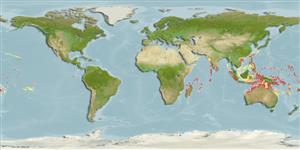
Indo-West Pacific: Comores, Maldive Islands; to Indonesia, Philippines, Caroline Islands, Papua New Guinea, Western Australia, and Fiji.
आकार / वज़न / Age
परिपक्व अवधि: Lm ? range ? - ? cm
Max length : 3.0 cm SL पुल्लिंग / अलिंग; (Ref. 48637)
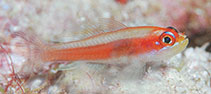
पृष्ठीय रीढ़ (सम्पूर्ण) : 6 - 7; पृष्ठीय सौफट रेज़ (सम्पूर्ण) : 8; गुदा कांटा: 1; ऐनल सौफट रेज़: 8. Distinguished by the following characters: a bony interorbital about 2/3 pupil diameter in width and only slightly concave; absence of troughs or trenches in the interorbital or posterodorsal orbital regions; unbranched fifth pelvic-fin ray, 50-60% fourth ray; epaxialis extending anteriorly to a vertical in line with the posterior margin of the orbit (Ref. 100726); no elongated spines; all pectoral rays unbranched; longitudinal scale series 23; absence of predorsal scales on midline; 1-2 deciduous scales on upper opercle; depth of body 4.0-4.1 in SL; semi-translucent pink on upper half of body (straw-yellow, translucent above midlateral septum, Ref. 100726); midlateral stripe is broad and reddish orange in color; breast and belly, white; narrow light blue lines below eye, dorsal midline of snout and behind upper rear corner of eye (Ref. 90102).
Body shape (shape guide): fusiform / normal; Cross section: compressed.
Inhabits coastal reef slopes and lagoons. Found along reef margins with rubble (Ref. 48637). Also found in caves and crevices, often on drop-offs in 3-35 m (Ref. 90102). A relatively rare species in collections, usually been taken in lots of one or two specimens (Ref. 100726)..
Life cycle and mating behavior
परिपक्व अवधि | पुनरुत्पत्ति | मछलीऔ का अंडे देना | अंडे | Fecundity | लार्वा
Winterbottom, R. and D.F. Hoese, 2015. A revision of the Australian species of Trimma (Actinopterygii, Gobiidae), with descriptions of six new species and redescriptions of twenty-three valid species. Zootaxa 3934(1):001-102. (Ref. 100726)
IUCN Red List Status (Ref. 130435: Version 2025-1)
Threat to humans
Harmless
Human uses
मात्स्यिकी: कोई रुचि बग़ैर
साधन
Special reports
Download XML
इंटरनेट स्रोत
Estimates based on models
Preferred temperature (संदर्भ
123201): 26.3 - 28.9, mean 27.8 °C (based on 302 cells).
Phylogenetic diversity index (संदर्भ
82804): PD
50 = 0.5000 [Uniqueness, from 0.5 = low to 2.0 = high].
Bayesian length-weight: a=0.01023 (0.00477 - 0.02194), b=3.01 (2.83 - 3.19), in cm total length, based on LWR estimates for this (Sub)family-body shape (Ref.
93245).
लौटाव (संदर्भ
120179): ऊंचा, न्यूनतम जनसंख्या दुगनी समय अवलागत 15 महीने। (Preliminary K or Fecundity.).
Fishing Vulnerability (Ref.
59153): Low vulnerability (10 of 100).
🛈
Nutrients (Ref.
124155): Calcium = 868 [367, 2,774] mg/100g; Iron = 2.64 [1.33, 5.75] mg/100g; Protein = 17.4 [15.4, 19.1] %; Omega3 = 0.284 [0.101, 0.699] g/100g; Selenium = 42 [16, 105] μg/100g; VitaminA = 36.4 [9.3, 133.8] μg/100g; Zinc = 3.5 [2.1, 5.7] mg/100g (wet weight);