>
Tetraodontiformes (Puffers and filefishes) >
Tetraodontidae (Puffers) > Canthigasterinae
Etymology: Canthigaster: Greek, kanthos = the outer or inner corner of the eye, where the lids meet, 1646 + Greek, gaster = stomach (Ref. 45335); figueiredoi: Named in honor of José Lima de Figueiredo, for his contributions to the advancement of the taxonomy of Brazilian marine fishes, as well as for his long term encouragement and support to the authors (Ref. 43205).
Eponymy: Dr José Lima de Figueiredo (d: 1943) aka ‘Ze Lima’ is a Brazilian ichthyologist who is a former researcher and Curator of Fishes at the Zoological Museum of the University of São Paulo. [...] (Ref. 128868), visit book page.
Environment: milieu / climate zone / rango de profundidad / distribution range
Ecología
marino asociado a arrecife; rango de profundidad 1 - 70 m (Ref. 43205). Tropical; 9°N - 33°S
Western Atlantic: southern Caribbean to Santa Catarina, Brazil, including the oceanic islands of Atol das Rocas and Fernando de Noronha.
Tamaño / Peso / Age
Madurez: Lm ? range ? - ? cm
Max length : 12.0 cm NG macho / no sexado; (Ref. 42064)
Short description
Claves de identificación | Morfología | Morfometría
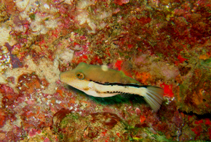
Espinas dorsales (total) : 0; Radios blandos dorsales (total) : 9 - 10; Espinas anales: 0; Radios blandos anales: 9. Differs from other Atlantic Canthigaster species by the long anterior extension of the lower horizontal dark stripe on the flank (composed of irregular horizontal and diagonal bars and originating as a solid stripe on the ventral caudal fin margin). This stripe reaches the pectoral fin base. Differs from C. jamestyleri by the presence of a dark caudal-fin margin, the absence of vertically oriented bars on the caudal fin, the possession of fewer stripes and spots on body especially on the dorsum, as well as by the absence of a small black irregular spot on the anal fin base (Ref. 43205).
Body shape (shape guide): short and / or deep.
Inhabits coral-rich as well as coral-poor areas, and areas with rocky bottoms (Ref. 43205). Maximum depth from Ref. 126840. Often in pairs, hovering over the reef during the day (Ref. 43205). Feeds on vegetation, sponges, crustaceans, and mollusks (Ref. 42064).
Life cycle and mating behavior
Madurez | Reproducción | Puesta | Huevos | Fecundidad | Larva
Moura, R.L. and R.M.C. Castro, 2002. Revision of Atlantic sharpnose pufferfishes (Tetraodontiformes: Tetraodontidae: Canthigaster), with description of three new species. Proc. Biol. Soc. Wash. 115(1):32-50. (Ref. 43205)
IUCN Red List Status (Ref. 130435: Version 2025-1)
Threat to humans
Harmless
Human uses
Pesquerías: comercial; Acuario: Comercial
Herramientas
Special reports
Download XML
Fuentes de Internet
Estimates based on models
Preferred temperature (Referencia
123201): 23.4 - 27.6, mean 27 °C (based on 177 cells).
Phylogenetic diversity index (Referencia
82804): PD
50 = 0.5000 [Uniqueness, from 0.5 = low to 2.0 = high].
Bayesian length-weight: a=0.03631 (0.01554 - 0.08482), b=2.88 (2.69 - 3.07), in cm total length, based on LWR estimates for this Genus-body shape (Ref.
93245).
Nivel trófico (Referencia
69278): 3.1 ±0.36 se; based on food items.
Resiliencia (Referencia
120179): Alto, población duplicada en un tiempo mínimo inferior a 15 meses (Preliminary K or Fecundity.).
Fishing Vulnerability (Ref.
59153): Low vulnerability (10 of 100).
🛈
Nutrients (Ref.
124155): Calcium = 107 [49, 256] mg/100g; Iron = 1 [0, 2] mg/100g; Protein = 18.1 [15.9, 20.3] %; Omega3 = 0.127 [0.061, 0.255] g/100g; Selenium = 35.6 [16.9, 79.5] μg/100g; VitaminA = 49.6 [13.6, 189.5] μg/100g; Zinc = 1.69 [1.08, 2.55] mg/100g (wet weight);