Classification / Names
Nomi Comuni | Sinonimi | Catalog of Fishes(Genere, Specie) | ITIS | CoL | WoRMS | Cloffa
>
Siluriformes (Catfishes) >
Loricariidae (Armored catfishes) > Hypoptopomatinae
Etymology: Curculionichthys: Derived from the from the Latin 'curculionem' (elongated snout) and from the Greek 'ichthys' (fishes), in reference to the relatively elongated snouts of the fish species included in this genus.
Environment: milieu / climate zone / distribuzione batimetrica / distribution range
Ecologia
; acqua dolce demersale. Tropical
South America: Upper Rio Paraná drainage in Brazil.
Size / Peso / Age
Maturità: Lm ? range ? - ? cm
Max length : 3.0 cm SL maschio/sesso non determinato; (Ref. 53011)
Short description
Chiavi di identificazione | Morfologia | Morfometria
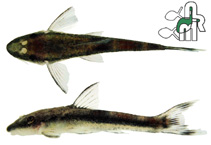
Raggi dorsali molli (totale) : 8; Raggi anali molli: 6. Differs from all other known species of Hisonotus by the combination of a pair of rostral plates covering the tip of the snout; lateralis canal in almost every plate along length of body; lateral line uninterrupted by gaps, almost complete, with 22 perforated plates + 1 to 3 plates with no canal; a pectoral spine that is smooth and lacks odontodes along its posterior dorsal margin for a distance more than one-half of its width; and a scapular bridge that is completely exposed or with a very reduced median pair of arrector fossae (Ref. 53011).
Body shape (shape guide): elongated.
Inhabits streams, with banks covered by vegetation partially submerged into the water (Ref. 53011).
Life cycle and mating behavior
Maturità | Riproduzione | Deposizione | Uova | Fecundity | Larve
Roxo, F.F., G.S.C. Silva, L.E. Ochoa and C. Oliveira, 2015. Description of a new genus and three new species of Otothyrinae (Siluriformes, Loricariidae). Zookeys 534:103-134. (Ref. 113800)
IUCN Red List Status (Ref. 130435: Version 2025-1)
Threat to humans
Harmless
Human uses
Pesca: di nessun interesse
Strumenti
Special reports
Download XML
Fonti Internet
Estimates based on models
Phylogenetic diversity index (Fonte Biblio.
82804): PD
50 = 0.5001 [Uniqueness, from 0.5 = low to 2.0 = high].
Bayesian length-weight: a=0.00851 (0.00374 - 0.01935), b=3.09 (2.90 - 3.28), in cm total length, based on LWR estimates for this (Sub)family-body shape (Ref.
93245).
Trophic level (Fonte Biblio.
69278): 2.4 ±0.1 se; based on size and trophs of closest relatives
Fishing Vulnerability (Ref.
59153): Low vulnerability (10 of 100).
🛈