>
Cypriniformes (Carps) >
Nemacheilidae (Brook loaches)
Etymology: Schistura: Greek, schizein = to divide + Greek, oura = tail; an allusion to forked caudal fins (Ref. 45335); spiesi: Named for John Spies, Australian speleologist and pioneer in ecological and archaeological cave studies and conservation in Thailand.
Eponymy: John Spies (d: 1956) is an Australian photographer, speleologist and pioneer in ecological and archaeological cave studies and conservation in Thailand, where he has lived for more than thirty years and where this species occurs. [...] (Ref. 128868), visit book page.
More on authors: Vidthayanon & Kottelat.
Environment: milieu / climate zone / εύρος βάθους / distribution range
Οικολογία
; Γλυκού νερού βενθοπελαγικό. Tropical
Asia: Tham Phra Wang Daeng cave in Thailand.
Μέγεθος / Βάρος / Age
Γεννητική Ωρίμανση: Lm ? range ? - ? cm
Max length : 11.9 cm SL αρσενικό/απροσδιόριστο; (Ref. 51711)
Short description
Κλείδες προσδιορισμού | Μορφολογία | Μορφομετρία
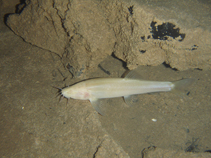
Μαλακές ραχιαίες ακτίνες (συνολικά) : 12; Μαλακές εδρικές ακτίνες: 8. Body pinkish white in life, without color pattern; developed suborbital flap in male, with groove behind flap extending for some distance anteriorly and posteriorly; a long, pointed flap-like nostril tube; eye subcutaneous, vestigial, in a small pit, or apparently missing; eye pit or slit always present and connected with groove bordering suborbital flap in male or with a groove in homologous position in female; eye becoming indistinct at about 8 cm SL; snout depressed; over about 6.5 SL, back humped behind nape, especially in males (Ref. 51711).
Body shape (shape guide): elongated.
Inhabits cave, most commonly found resting on the bottom of shallow pools with flowing water. Sometimes occurs in mid-water, or also co-exists with Neolissochilus subterraneus in deeper areas with little flow. Swims along the surface of pools with its snout raised up, out of the water while moving it head from side to side. Large fish occur in the deeper zone, far from the entrance of the cave.
Life cycle and mating behavior
Γεννητική Ωρίμανση | Αναπαραγωγή | Γεννοβολία | Αβγά | Γονιμότητα | Προνύμφες
Vidthayanon, C. and M. Kottelat, 2003. Three new species of fishes from Tham Phra Wang Daeng and Tham Phra Sai Ngam caves in northern Thailand (Teleostei: Cyprinidae and Balitoridae). Ichthyol. Explor. Freshwat. 14(2):159-174. (Ref. 51711)
IUCN Red List Status (Ref. 130435: Version 2025-1)
Threat to humans
Harmless
Human uses
αλιεία: χωρίς ενδιαφέρον
Εργαλεία
Special reports
Download XML
Διαδικτυακές πηγές
Estimates based on models
Phylogenetic diversity index (Αναφ.
82804): PD
50 = 0.5000 [Uniqueness, from 0.5 = low to 2.0 = high].
Bayesian length-weight: a=0.00692 (0.00310 - 0.01545), b=3.02 (2.85 - 3.19), in cm total length, based on LWR estimates for this Genus-body shape (Ref.
93245).
Τροφικό Επίπεδο (Αναφ.
69278): 3.0 ±0.3 se; based on size and trophs of closest relatives
Ελαστικότητα (Αναφ.
120179): Μεσαίο(α), ελάχιστος χρόνος για διπλασιασμό πληθυσμού 1,4 - 4,4 έτη (Preliminary K or Fecundity.).
Fishing Vulnerability (Ref.
59153): Low vulnerability (10 of 100).
🛈