Classification / Names
Nombres comunes | Sinónimos | Catalog of Fishes(Género, Especie) | ITIS | CoL | WoRMS | Cloffa
>
Cyprinodontiformes (Rivulines, killifishes and live bearers) >
Rivulidae (Rivulines) > Cynolebiinae
Eponymy: Dr Eugenio Izecksohn (1932–2013) was a Brazilian herpetologist and a specialist in Neotropical anurans. [...] (Ref. 128868), visit book page.
Environment: milieu / climate zone / rango de profundidad / distribution range
Ecología
; agua dulce bentopelágico. Tropical
South America: Atlantic coastal river basins in Brazil.
Tamaño / Peso / Age
Madurez: Lm ? range ? - ? cm
Max length : 6.0 cm TL macho / no sexado; (Ref. 36579)
Short description
Claves de identificación | Morfología | Morfometría
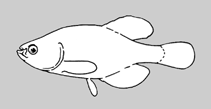
Radios blandos dorsales (total) : 13 - 18; Radios blandos anales: 19 - 23; Vértebra: 27 - 28. Xenurolebias izecksohni is distinguished from all other species of Xenurolebias by lacking light spots on the distal half of the dorsal fin in males (vs. presence) and having oblique short bars on the ventral portion of the caudal fin in males (vs. absence). It also differs from X. myersi by having the caudal fin lanceolate in males, with a pronounced posterior tip (vs. sub-lanceolate, never forming a distinctive tip posteriorly), more dark grey bars on the flank in females (12-13 vs. 9-11), a more slender body (body depth 27.1-28.5% SL in males and 28.5-30.6% in females, vs. 29.0-31.4% and 30.1-33.9%), and a shorter lower jaw (18.6-20.9% of head length in males and 17.7-19.7% in females, vs. 22.4-24.5% and 19.6-21.4%, respectively); from X. pataxo by the possession of two or three black spots on the posterior part of the caudal peduncle in females (vs. absence); and from X. cricarensis by having a more slender head in males (head depth 81.2-85.0% of head length vs. 85.6-92.8%), a shorter lower jaw in males (18.6-20.9% of head length vs. 22.0-25.0%) and a more slender body in larger males (above 31 mm SL) (body depth 27.1-27.5% SL, vs. 30.7-33.9% SL) (Ref. 96072).
Body shape (shape guide): elongated.
Life cycle and mating behavior
Madurez | Reproducción | Puesta | Huevos | Fecundidad | Larva
Costa, W.J.E.M. and P.F. Amorim, 2014. Integrative taxonomy and conservation of seasonal killifishes, Xenurolebias (Teleostei: Rivulidae), and the Brazilian Atlantic forest. Systematic and Biodiversity (Ref. 96072)
IUCN Red List Status (Ref. 130435: Version 2025-1)
Threat to humans
Harmless
Human uses
Herramientas
Special reports
Download XML
Fuentes de Internet
Estimates based on models
Phylogenetic diversity index (Referencia
82804): PD
50 = 0.5625 [Uniqueness, from 0.5 = low to 2.0 = high].
Bayesian length-weight: a=0.01000 (0.00244 - 0.04107), b=3.04 (2.81 - 3.27), in cm total length, based on all LWR estimates for this body shape (Ref.
93245).
Nivel trófico (Referencia
69278): 3.2 ±0.4 se; based on size and trophs of closest relatives
Resiliencia (Referencia
120179): Alto, población duplicada en un tiempo mínimo inferior a 15 meses (Preliminary K or Fecundity.).
Fishing Vulnerability (Ref.
59153): Low vulnerability (10 of 100).
🛈