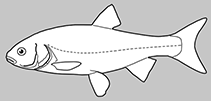
Klassifizierung / Names
Namen | Synonyme | Catalog of Fishes(Gattung, Arten) | ITIS | CoL | WoRMS | Cloffa
>
Cypriniformes (Carps) >
Leuciscidae (Minnows) > Pogonichthyinae
Etymology: Notropis: A misnomer given by Rafinesque to shriveled specimens, with the meaning of "back keel"; from Greek, noton = back (Ref. 45335); calabazas: Named for its known habitat, Rí0 Calabazas; noun in apposition.
Environment: milieu / climate zone / Tiefenbereich / distribution range
Ökologie
; süßwasser benthopelagisch. Tropical
South America: Rio Panuco basin in central Mexico.
Size / Gewicht / Alter
Geschlechtsreife: Lm ? range ? - ? cm
Max length : 2.7 cm SL Männchen/unbestimmt; (Ref. 54509)
Kurzbeschreibung
Bestimmungsschlüssel | Morphologie | Morphometrie
Rückenflossenstacheln (insgesamt) : 0; Rückenflossenweichstrahlen (insgesamt) : 8 - 9; Afterflossenweichstrahlen: 7 - 9. Having eight (occasionally seven or nine) anal rays; 36-40 lateral line scales, of which 22-37 are pored; 25-28 circumferential scales round the body and 15-17 circumferential scales around the caudal peduncle; 11-13 total gill rakers on the first gill arch and 17-19 on the second; 9-14 infraorbital pores (usually 9-11) in an interrupted canal that extends onto the snout; and 5-8 supraorbital pores (usually 5-6) in either a continuous or interrupted canal (Ref. 54509).
Life cycle and mating behavior
Geschlechtsreife | Fortpflanzung | Ablaichen | Eier | Fecundity | Larven
Lyons, J. and N. Mercado-Silva, 2004. Notropis calabazas (Teleostei: Cyprinidae): New species from the Rio Pánuco Basin of Central México. Copeia 2004(4):868-875. (Ref. 54509)
IUCN Rote Liste Status (Ref. 130435: Version 2025-1)
Bedrohung für Menschen
Harmless
Nutzung durch Menschen
Tools
Zusatzinformationen
Download XML
Internet Quellen
Estimates based on models
Phylogenetic diversity index (Ref.
82804): PD
50 = 0.5000 [Uniqueness, from 0.5 = low to 2.0 = high].
Bayesian length-weight: a=0.01000 (0.00244 - 0.04107), b=3.04 (2.81 - 3.27), in cm total length, based on all LWR estimates for this body shape (Ref.
93245).
Trophic level (Ref.
69278): 3.0 ±0.3 se; based on size and trophs of closest relatives
Widerstandsfähigkeit (Ref.
120179): hoch, Verdopplung der Population dauert weniger als 15 Monate. (Preliminary K or Fecundity.).
Fishing Vulnerability (Ref.
59153): Low vulnerability (10 of 100).
🛈