Classification / Names
Noms communs | Synonymes | Catalog of Fishes(Genre, Espèce) | ITIS | CoL | WoRMS | Cloffa
>
Anabantiformes (Gouramies, snakeheads) >
Osphronemidae (Gouramies) > Macropodusinae
Etymology: Betta: Malay/Javanese origin. Bleeker (1850, 1858) indicates Ikan Wadder Bettah as the local name of Betta trifasciata Bleeker, 1849 (now Betta picta, Valenciennes, 1846) in the Ambarawa Javanese dialect. Ikan Wader is a common Javanese name for smaller freshwater fishes, especially cyprinids (already used in Old Javanese). See Blust, R. & Trussel, S. Austronesian Comparative Dictionary. Web Edition (https://www.trussel2.com/acd/); ibanorum: Iban is the vernacular for the indigenous people of northwestern Borneo.
Eponymy: The Ibans, also called Sea Dayaks, are an indigenous people of northwestern Borneo, where this species occurs. (Ref. 128868), visit book page.
Environment: milieu / climate zone / profondeur / distribution range
Écologie
; eau douce benthopélagique. Tropical
Asia: southern Sarawak, Malaysia.
Taille / Poids / Âge
Maturité: Lm ? range ? - ? cm
Max length : 8.1 cm SL mâle / non sexé; (Ref. 55025)
Description synthétique
Clés d'identification | Morphologie | Morphométrie
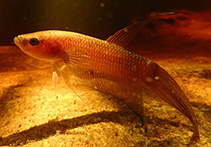
Épines dorsales (Total) : 1; Rayons mous dorsaux (Total) : 8 - 10; Épines anales: 1 - 2; Rayons mous anaux: 25 - 27; Vertèbres: 30 - 32. Differs from other members of the species group by the following combination of characters: opercle without second postorbital stripe; eye color yellow when live; anal fin rays 27-29 (mode 28); subdorsal scales 5-6 (mode 5); lateral scales 30-32 (mode 30); predorsal scales 21-23 (mode 22); postdorsal scales 10-11 (mode 11); preanal length 45.8-49.4% SL; head length 31.7-36.4% SL; anal fin base length 50.0-55.8% SL (Ref. 55025).
Body shape (shape guide): fusiform / normal.
Facultative air-breathing (Ref. 126274); Found only in blackwater habitats, with water tinged orange in color due to leaching of tannins from dead plant matter and peat (Ref. 55025). Observed as paternal oral brooder with the typical egg-chase (Ref. 55025). Also Ref. 84801.
Life cycle and mating behavior
Maturité | Reproduction | Frai | Œufs | Fécondité | Larves
Tan, H.H. and P.K.L. Ng, 2004. Two new species of freshwater fish (Teleostei: Balitoridae, Osphronemidae) from southern Sarawak. p. 267-284. In H.S. Yong, F.S.P. Ng and E.E.L. Yen (eds.) Sarawak Bau Limestone Biodiversity. The Sarawak Museum Journal 59(80) (New Series); Special Issue No. 6. (Ref. 55025)
Statut dans la liste rouge de l'IUCN (Ref. 130435: Version 2025-1)
Menace pour l'homme
Harmless
Utilisations par l'homme
Outils
Articles particuliers
Télécharger en XML
Sources Internet
Estimates based on models
Phylogenetic diversity index (Réf.
82804): PD
50 = 0.5000 [Uniqueness, from 0.5 = low to 2.0 = high].
Bayesian length-weight: a=0.01000 (0.00377 - 0.02651), b=2.97 (2.74 - 3.20), in cm total length, based on LWR estimates for this (Sub)family-body shape (Ref.
93245).
Niveau trophique (Réf.
69278): 3.3 ±0.4 se; based on size and trophs of closest relatives
Résilience (Réf.
120179): Haut, temps minimum de doublement de population inférieur à 15 mois (Preliminary K or Fecundity.).
Fishing Vulnerability (Ref.
59153): Low vulnerability (10 of 100).
🛈