Classification / Names
ชื่อสามัญ | ชื่อพ้อง | Catalog of Fishes(สกุล, ชนิด) | ITIS | CoL | WoRMS | Cloffa
sub class Elasmobranchii (ฉลามและกระเบน) (sharks and rays) >
Heterodontiformes (Bullhead and horn sharks) >
Heterodontidae (Bullhead, horn, or Port Jackson sharks)
Etymology: Heterodontus: heteros (Gr.), different; odontos (Gr.), tooth, referring to pointy teeth (for clutching prey) at front of jaws, different than rounded molar-like teeth (for grinding hard-shelled invertebrates) at the back (See ETYFish); omanensis: -ensis, Latin suffix denoting place: Gulf of Masira, Central Oman, Arabian Sea, type locality (See ETYFish).
Environment: milieu / climate zone / ระดับความลึก / distribution range
นิเวศวิทยา
เกี่ยวกับทะเล,น้ำเค็ม สัตว์น้ำหน้าดิน; ระดับความลึก 72 - 80 m (Ref. 106604). Tropical
Western Indian Ocean: Central Oman.
ขนาด / น้ำหนัก / Age
วัยเจริญพันธุ์: Lm ? range ? - ? cm
Max length : 56.0 cm TL เพศผู้/กระเทย; (Ref. 54826); 61.0 cm TL (female)
Short description
เครื่องมือที่ใช้ในการแยกชนิดสัตว์,สิ่งมีชีวิตออกจากกัน | สัณฐานวิทยา | ความยาวต่างๆ
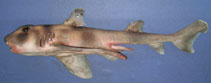
สัตว์มีกระดูกสันหลัง: 98. Diagnosis: Four dark saddles, more or less equally distributed along the head and body. Relatively small, dark pigmented dorsal fins, each with a white distal streak. Large pectoral fins. Unique egg case, with 2 long tendrils extending from its base and flanges with 2 turns. This species differs from H. japonicus in having 4 dark saddles (vs. 11-14); a smaller first-dorsal fin (9.3-10.9% TL vs. 11-21% TL); an egg case of 2 turns (vs. 3), bearing extremely long tendrils (vs. short) (Ref. 54826).
Body shape (shape guide): elongated.
Life cycle and mating behavior
วัยเจริญพันธุ์ | การสืบพันธุ์ | การวางไข่ | เซลสืบพันธ์ของเพศเมีย(ไข่) | ความดกของไข่ | ตัวอ่อน
Baldwin, Z.H., 2005. A new species of bullhead shark, genus Heterodontus (Heterodontiformes: Heterodontidae), from Oman. Copeia 2005(2):262-264. (Ref. 54826)
IUCN Red List Status (Ref. 130435: Version 2025-1)
Threat to humans
Harmless
Human uses
เครื่องมือ
Special reports
Download XML
แหล่งที่มาจากอินเตอร์เน็ต
Estimates based on models
Phylogenetic diversity index (อ้างอิง
82804): PD
50 = 0.5029 [Uniqueness, from 0.5 = low to 2.0 = high].
Bayesian length-weight: a=0.00380 (0.00165 - 0.00876), b=3.15 (2.95 - 3.35), in cm total length, based on LWR estimates for this (Sub)family-body shape (Ref.
93245).
ระดับชั้นอาหาร (อ้างอิง
69278): 3.5 ±0.6 se; based on size and trophs of closest relatives
Fishing Vulnerability (Ref.
59153): Moderate vulnerability (44 of 100).
🛈