Classification / Names
Tên thường gặp | Các synonym ( Các tên trùng) | Catalog of Fishes(Giống, Các loài) | ITIS | CoL | WoRMS | Cloffa
>
Gymnotiformes (Knifefishes) >
Gymnotidae (Naked-back knifefishes) > Gymnotinae
Etymology: Gymnotus: Greek, gymnos = naked (Ref. 45335); obscurus: Name from the Latin word 'obscurus' meaning dark, referring to its predominantly dark coloration.
Environment: milieu / climate zone / Mức độ sâu / distribution range
Sinh thái học
; Nước ngọt Sống nổi và đáy. Tropical
South America: varzea floodplain at the conflluence of the Rio Solimoes (Amazon) and the Rio Japura in Mamiraua Reserve near the Tefé, Amazonas, Brazil.
Bộ gần gũi / Khối lượng (Trọng lượng) / Age
Chín muồi sinh dục: Lm ? range ? - ? cm
Max length : 21.5 cm TL con đực/không giới tính; (Ref. 55508)
Short description
Khóa để định loại | Hình thái học | Sinh trắc học
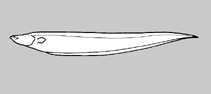
Các tia vây lưng cứng (tổng cộng) : 0; Các vây lưng mềm (tổng cộng) : 0; Tia mềm vây hậu môn: 210 - 250. Distinguished from its congeners endemic to the Amazon and Orinoco Basins and the Guyana Shield in having many pectoral-fin rays 20-22; and a color pattern of oblique and undivided thin pale bands, less than one-quarter width of dark bands, with straight high-contrast margins, which extend to the dorsal midline on the anterior half of the body, and of which many are interrupted at the ventral margin of the hypaxial muscles along the anterior two-thirds of the body. Differs further from congeners endemic to the Amazon-Orinoco basins and the Guyana Shield in having the following unique combination of characters: clear (unpigmented) patch at the caudal end of the anal-fin membrane in specimens 6.0-23.5 TL; and bands never divided to form band pairs (Ref. 55508).
Facultative air-breathing in the genus (Ref. 126274); Inhabits root mats of floating meadows in floodplains. In the whitewater floodplain, juveniles are encountered in patches of floating macrophytes along lakes margins and along the edge of canos (drainage channels from lakes to the main river channels) and paranás (channels connected at both ends to the main river channel that transport whitewater through the floodplain). Floating macrophytes form extensive floating meadows. Undertakes aerial respiration by gulping atmospheric air into the hypervascularized posterior chamber of the gas bladder. Feeds primarily on chironomid larvae, small insect nymphs and small crustaceans (Ref. 55508).
Life cycle and mating behavior
Chín muồi sinh dục | Sự tái sinh sản | Đẻ trứng | Các trứng | Sự sinh sản | Ấu trùng
Crampton, W.G.R., D.H. Thorsen and J.S. Albert, 2005. Three new species from a diverse, sympatric assemblage of the electric fish Gymnotus (Gymnotiformes: Gymnotidae) in the lowland Amazon basin, with notes on ecology. Copeia 2005(1):82-99. (Ref. 55508)
IUCN Red List Status (Ref. 130435: Version 2025-1)
Threat to humans
Harmless
Human uses
Các công cụ
Special reports
Download XML
Các nguồn internet
Estimates based on models
Phylogenetic diversity index (Tài liệu tham khảo
82804): PD
50 = 0.5000 [Uniqueness, from 0.5 = low to 2.0 = high].
Bayesian length-weight: a=0.01000 (0.00244 - 0.04107), b=3.04 (2.81 - 3.27), in cm total length, based on all LWR estimates for this body shape (Ref.
93245).
Mức dinh dưỡng (Tài liệu tham khảo
69278): 3.3 ±0.4 se; based on size and trophs of closest relatives
Thích nghi nhanh (Tài liệu tham khảo
120179): Chiêù cao, thời gian nhân đôi của chủng quần tối thiểu là dưới 15 tháng (Preliminary K or Fecundity.).
Fishing Vulnerability (Ref.
59153): Low vulnerability (12 of 100).
🛈