>
Cypriniformes (Carps) >
Xenocyprididae (East Asian minnows)
Etymology: Megalobrama: Greek, megalos = great + old French breme, bresme, a fresh water fish; 1460 (Ref. 45335).
Environment: milieu / climate zone / profondeur / distribution range
Écologie
; eau douce benthopélagique. Subtropical
Asia: Amur River southward to the Yangtze River drainage and rivers further southward draining to the South China Sea, excluding Zhu Jiang and Xi Jiang.
Length at first maturity / Taille / Poids / Âge
Maturité: Lm ?, range 30 - ? cm
Max length : 37.7 cm mâle / non sexé; (Ref. 51498)
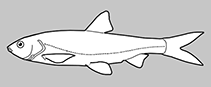
Épines dorsales (Total) : 3; Rayons mous dorsaux (Total) : 7 - 8; Épines anales: 3; Rayons mous anaux: 28 - 33; Vertèbres: 37 - 41. Distinguished by the following characters: vertebrae (without 4 vertebrae of the Weberian apparatus) not exceeding 37; for fishes with over 15 cm body length, there are 7-9 longitudinal rows of scales between the lateral line and insertion of the ventral fin; body depth 1.7-2.5 in l; length of dorsal spine exceeds that of head, depth of caudal peduncle is as a rule less than its length, width of oral slit is less than two times in head width; corneous sheaths usually thin, on upper jaw appear as a thin crescent (distinct in small specimens), rarer triangular; supraorbitale in small specimens relatively narrow, like a thin crescent, in large specimens it is triangular or trapezoid; the swim bladder is three chambered, the third chamber is usually very reduced; the anterior body outline in adults usually has a clearly seen depression at the level of the end of the head followed by an abruptly ascending "hump", depth of the head at the level of this depression frequently makes up 40% of the greatest body depth. In adults (1>15 cm) on scales in the anterior body sides (including scales of the lateral line and several rows above and below the lateral line) in the posterior (outer) part there is an opaque sector with black dots either all over this sector or only along its posterior margin; the dorsal side very dark, almost black, the sides and belly slightly lighter (Ref. 51498).
Usually does not occur in main channel of the river but in the system of auxiliary waters with aquatic vegetation and conditions suitable for feeding and reproduction (Ref. 51498). Feeds principally on mollusks, but also takes filamentous algae, higher plants, crustaceans, insect larvae and small fish (Ref. 51498).
Vasil'eva, E.D. and A.P. Makeeva, 2003. Taxonomic status of the Black Amur bream and some remarks on problems of taxonomy of the genera Megalobrama and Sinibrama (Cyprinidae, Cultrinae). J. Ichthyol. 43(8):582-597. (Ref. 51498)
Statut dans la liste rouge de l'IUCN (Ref. 130435: Version 2025-1)
Menace pour l'homme
Harmless
Utilisations par l'homme
Outils
Articles particuliers
Télécharger en XML
Sources Internet
Estimates based on models
Phylogenetic diversity index (Réf.
82804): PD
50 = 0.5312 [Uniqueness, from 0.5 = low to 2.0 = high].
Bayesian length-weight: a=0.01549 (0.00823 - 0.02913), b=3.06 (2.89 - 3.23), in cm total length, based on LWR estimates for this species & (Sub)family-body (Ref.
93245).
Niveau trophique (Réf.
69278): 3.3 ±0.46 se; based on food items.
Résilience (Réf.
120179): Milieu, temps minimum de doublement de population : 1,4 à 4,4 années (tm=3-6; Fec=177,000).
Fishing Vulnerability (Ref.
59153): High vulnerability (56 of 100).
🛈