>
Siluriformes (Catfishes) >
Ictaluridae (North American freshwater catfishes)
Etymology: Noturus: Greek, noton = back + Greek, oura = tail; refred to the position of the tail over the back (Ref. 45335); crypticus: Name from the Greek stem 'kryptos', meaning hidden or secret, referring to this species' secretive habits, and for having kept its identity in secret for so long.
Environment: milieu / Klimaatzone / Diepte / distribution range
Ecologie
; zoet water benthopelagisch. Tropical
North America: USA.
Grootte / Gewicht / Leeftijd
Maturiteit: Lm ? range ? - ? cm
Max length : 6.5 cm SL mannelijk / geslacht onbekend; (Ref. 56218)
Korte beschrijving
Determinatiesleutels | Morfologie | Morfometrie
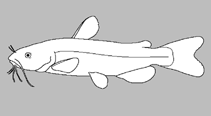
Dorsale zachte stralen (totaal) : 6; Anale zachte stralen: 15 - 17. Diagnosis: Distinguished from other members of the Noturus elegans species group by having: modally 16 anal rays (vs. 18 in Noturus fasciatus); modally 8 pelvic rays (vs. 9); 2-10 medium-large sized melanophores on the cheek (vs. large melanophores absent on cheek); adipose fin band extending only to base or half-way up fin (vs. extending half-way up to edge of fin in fasciatus); adipose and caudal fins distinctly joined at their juncture (vs. weakly connected in fasciatus); three evenly spaced pale and dark bands in caudal fin (vs. caudal fin bands usually two and unevenly spaced); robust body shape, with body width at pectoral fin origin 23% or more of SL and greater than anal fin base length (vs. slender body shape, with body width at pectoral fin origin 22% or less of SL and less than anal fin base length). There is an absence of shared alleles for eight allozyme loci (mAAT-A, sACOHA, GPI-B, LDH-B, sMDHP-A, Pep-b, Pep-D, and PGM-A) distinguishes crypticus and fasciatus, which also differ by 5% Cytb sequence divergence. Similarly, both share no alleles at eight allozyme loci (mAAT-A, sAATA-A, sACOH-A, FUM-A, GPI-A, GPI-b, LDH-B, sMDHP-A, and Pep-D) and are 6.3% divergent for Cytb (Ref. 56218).
Levenscyclus en paargedrag
Maturiteit | Voortplanting | Paaien | Eieren | Fecunditeit | Larven
Burr, B.M., D.J. Eisenhour and J.M. Grady, 2005. Two new species of Noturus (Siluriformes: Ictaluridae) from the Tennessee River drainage: description, distribution, and conservation status. Copeia 2005(4):783-802. (Ref. 56218)
Status op de Rode Lijst van het IUCN (Ref. 130435: Version 2025-1)
Gevaar voor de mens
Harmless
Gebruik door de mens
Tools
Speciale rapporten
Download XML
Internetbronnen
Estimates based on models
Fylogenetische diversiteitsindex (Ref.
82804): PD
50 = 0.5000 [Uniqueness, from 0.5 = low to 2.0 = high].
Bayesian length-weight: a=0.01000 (0.00244 - 0.04107), b=3.04 (2.81 - 3.27), in cm total length, based on all LWR estimates for this body shape (Ref.
93245).
Trofisch niveau (Ref.
69278): 3.3 ±0.4 se; based on size and trophs of closest relatives
Weerstandsvermogen (Ref.
120179): Hoog, minimale populatieverdubbelingstijd minder dan 15 maanden (Preliminary K or Fecundity.).
Fishing Vulnerability (Ref.
59153): Low vulnerability (10 of 100).
🛈