



Thalasseleotris iota Hoese & Roberts, 2005
New Zealand pygmy sleeper
เพิ่มการสังเกตของคุณใน Fish Watcher
| Native range | All suitable habitat | Point map | Year 2050 |

|
| This map was computer-generated and has not yet been reviewed. |
| Thalasseleotris iota AquaMaps Data sources: GBIF OBIS |
อัพโหลดของคุณ ภาพถ่าย และ วิดีโอ
Google image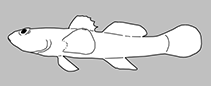 No image available for this species;
drawing shows typical species in Thalasseleotrididae.
Google image
drawing shows typical species in Thalasseleotrididae.
การจำแนกประเภท / ชื่อ ชื่อสามัญ | ชื่อพ้อง | Catalog of Fishes(สกุล, ชนิด) | ITIS | CoL | WoRMS | Cloffa
> Gobiiformes (Gobies) > Thalasseleotrididae (Ocean sleepers)
Etymology: Thalasseleotris: Greek, thalassa = the sea + The name of a Nile fish, eleotris (Ref. 45335); iota: Name from the Greek word 'iota' meaning very small, referring to its size.
More on authors: Hoese & Roberts.
Etymology: Thalasseleotris: Greek, thalassa = the sea + The name of a Nile fish, eleotris (Ref. 45335); iota: Name from the Greek word 'iota' meaning very small, referring to its size.
More on authors: Hoese & Roberts.
สิ่งแวดล้อม : สิ่งแวดล้อม / เขตภูมิอากาศ / ระดับความลึก / ระยะการกระจายสินค้า นิเวศวิทยา
เกี่ยวกับทะเล,น้ำเค็ม เกี่ยวกับหินโสโครก; ระดับความลึก 2 - 34 m (Ref. 57647). Tropical
การแพร่กระจาย อาณาเขต | พื้นที่จำแนกตาม FAO | ระบบนิเวศหลายระบบ | การปรากฏขึ้น,การเกิดขึ้น,พบ | ตำแหน่งบนแผนที่ | การแนะนำ | Faunafri
Southwest Pacific: New Zealand.
ขนาด / น้ำหนัก / อายุ
คำอธิบายสั้นๆ เครื่องมือที่ใช้ในการแยกชนิดสัตว์,สิ่งมีชีวิตออกจากกัน | สัณฐานวิทยา | ความยาวต่างๆ
เงี่ยงครีบหลัง (รวม) : 7 - 8; ก้านครีบอ่อนที่หาง (รวม) : 8 - 10; เงี่ยงครีบก้น: 1; ก้านครีบอ่อนที่ก้น: 7 - 9. Diagnosis: This species differs from T. adela Hoese & Larson, 1987, in having a narrower gill opening, extending forward to below posterior margin of eye or slightly behind eye (vs. under middle of eye); less extensively scaled body, with naked area reaching to below second dorsal origin or beyond (vs. near end of first dorsal fin); higher transverse scale count (usually 7 - 8 vs. 6 - 7); modally lower vertebral count (10+16 vs. 10+17); anterior nasal tube distinctly longer than posterior nasal tube (vs. subequal); two anal pterygiophores before first haemal spine (vs. 1); uppermost scale and lowermost scale on base of caudal fin with enlarged peripheral cteni (vs. no enlarged peripheral cteni). There are several color differences, including: lacking a black spot posteriorly on the first dorsal fin; usually 5 - 6 small black more or less rounded spots on the ventral midline of the caudal peduncle (vs. usually 4 horizontally elongate black spots); a broad black or dark brown area on basal third of pectoral fin (vs. no distinct black area or a small black spot dorsally on proximal upper 2 - 3 rays); dorsal, anal, and caudal fins with thin wavy grey lines (vs. uniformly pigmented); and no dark dorsomedian line on band before first dorsal fin (Ref. 57647).
Observed to be solitary and possibly, a territorial species. Inhabits broken rocky reefs with holes, crevices, and small caves; perches on rocky ledges partly overlain by silty sand or shell debris. Reported to be often collected underwater sharing caves with much larger black gobies Gobiopsis atrata. Its small size, cryptic habit, semi-transparency, and camouflage coloration make this fish very difficult to locate underwater; though readily collected with rotenone ichthyocide while scuba diving. The habitat of this species in New Zealand is very similar to that of T. adela in Australia, which is restricted to rocky reefs, often in silty turbid waters, at 1-24 m depth. May be collected using slurp gun or hand collected following controlled use of rotenone ichthyocide (Ref. 57647).
วงจรชีวิตและพฤติกรรมการผสมพันธุ์ วัยเจริญพันธุ์ | การสืบพันธุ์ | การวางไข่ | เซลสืบพันธ์ของเพศเมีย(ไข่) | ความดกของไข่ | ตัวอ่อน
อ้างอิงหลัก
อัพโหลดข้อมูลอ้างอิงของคุณ | อ้างอิง | ผู้ประสานงาน | ผู้ร่วมมือ
Hoese, D.F. and C.D. Roberts, 2005. A new species of the eleotrid genus Thalasseleotris (Teleostei: Gobioidei) from New Zealand coastal waters. J. R. Soc. N. Z. 35(4):417-431. (Ref. 57647)
สถานะบัญชีแดงของ IUCN (Ref. 130435: Version 2025-2 (Global))
Least Concern (LC) ; Date assessed: 21 March 2024
CITES
Not Evaluated
ภัยคุกคามต่อมนุษย์
Harmless
การใช้ของมนุษย์
การประมง: ผลประโยชน์ที่น่าจะเกิดขึ้น
FAO - Publication: search | FishSource |
ข้อมูลเพิ่มเติม
นิเวศวิทยาเขตร้อน
รายการอาหาร (เหยื่อ)
องค์ประอบของอาหาร
การบริโภคอาหาร
การจัดสรรอาหาร
ผู้ล่า
รายการอาหาร (เหยื่อ)
องค์ประอบของอาหาร
การบริโภคอาหาร
การจัดสรรอาหาร
ผู้ล่า
พลวัตของประชากร
พารามิเตอร์การเจริญเติบโต
อายุสูงสุด / ขนาด
ความยาว-น้ำหนักสัมพันธ์
ความยาว-ความยาวสัมพันธ์
ความยาว-ความถี่
การแปลงมวล
การทดแทนที่
อุดมสมบรูณ์
พารามิเตอร์การเจริญเติบโต
อายุสูงสุด / ขนาด
ความยาว-น้ำหนักสัมพันธ์
ความยาว-ความยาวสัมพันธ์
ความยาว-ความถี่
การแปลงมวล
การทดแทนที่
อุดมสมบรูณ์
วงจรชีวิต
การสืบพันธุ์
วัยเจริญพันธุ์
ความสมบูรณ์พันธุ์/เหงือกที่เกี่ยวข้อง
ความดกของไข่
การวางไข่
การรวมตัวของสปอน
เซลสืบพันธ์ของเพศเมีย(ไข่)
การพัฒนาไข่
ตัวอ่อน
พลวัตของสัตว์น้ำวัยอ่อน
การสืบพันธุ์
วัยเจริญพันธุ์
ความสมบูรณ์พันธุ์/เหงือกที่เกี่ยวข้อง
ความดกของไข่
การวางไข่
การรวมตัวของสปอน
เซลสืบพันธ์ของเพศเมีย(ไข่)
การพัฒนาไข่
ตัวอ่อน
พลวัตของสัตว์น้ำวัยอ่อน
การแพร่กระจาย
อาณาเขต
พื้นที่จำแนกตาม FAO
ระบบนิเวศหลายระบบ
การปรากฏขึ้น,การเกิดขึ้น,พบ
การแนะนำ
BRUVS - วิดีโอ
อาณาเขต
พื้นที่จำแนกตาม FAO
ระบบนิเวศหลายระบบ
การปรากฏขึ้น,การเกิดขึ้น,พบ
การแนะนำ
BRUVS - วิดีโอ
กายวิภาคศาสตร์
พื้นที่เหงือก
สมอง
หินโสต
พื้นที่เหงือก
สมอง
หินโสต
สรีรวิทยา
องค์ประกอบของร่างกาย
สารอาหาร
การใช้ออกซิเจน
ประเภทการว่ายน้ำ
ระดับความเร็วในการว่ายน้ำ
เม็ดสีที่มองเห็นได้
เสียงปลา
โรคและปรสิต
ความเป็นพิษ (LC50s)
องค์ประกอบของร่างกาย
สารอาหาร
การใช้ออกซิเจน
ประเภทการว่ายน้ำ
ระดับความเร็วในการว่ายน้ำ
เม็ดสีที่มองเห็นได้
เสียงปลา
โรคและปรสิต
ความเป็นพิษ (LC50s)
พันธุศาสตร์
จีโนม
พันธุศาสตร์
ความไม่สมดุลทางเชื้อชาติ
อัตราพันธุกรรม
ความหลากหลายทางพันธุกรรม
จีโนม
พันธุศาสตร์
ความไม่สมดุลทางเชื้อชาติ
อัตราพันธุกรรม
ความหลากหลายทางพันธุกรรม
เกี่ยวข้องกับมนุษย์
ระบบการเพาะเลี้ยงสัตว์น้ำ
ประวัติการเพาะเลี้ยงสัตว์น้ำ
สายพันธุ์
กรณีซิเกวเทอรา
แสตมป์ เหรียญ อื่นๆ
ระบบการเพาะเลี้ยงสัตว์น้ำ
ประวัติการเพาะเลี้ยงสัตว์น้ำ
สายพันธุ์
กรณีซิเกวเทอรา
แสตมป์ เหรียญ อื่นๆ
เครื่องมือ
หนังสืออิเล็กทรอนิกส์ | คู่มือภาคสนาม | ผู้มีความชำนาญในเรื่องความถี่ของความยาว | เครื่องมือในการศึกษาชีวประวัติ | ตำแหน่งบนแผนที่ |
จับ-MSY |
รายงานพิเศษ
ตรวจสอบการบำรุงรักษาตู้ปลา | ตรวจสอบเอกสารข้อเท็จจริงเกี่ยวกับสายพันธุ์ | ตรวจสอบเอกสารข้อเท็จจริงเกี่ยวกับการเพาะเลี้ยงสัตว์น้ำ
ดาวน์โหลด XML
หน้าสรุป | ข้อมูลสำคัญ | ชื่อสามัญ | ภาพถ่าย
แหล่งที่มาจากอินเตอร์เน็ต
AFORO (otoliths) | Aquatic Commons | BHL | Cloffa | Websites from users | Check FishWatcher | CISTI | Catalog of Fishes: สกุล, ชนิด | DiscoverLife | ECOTOX | FAO - Publication: search | Faunafri | Fishipedia | Fishtrace | GloBI | Google Books | Google Scholar | Google | IGFA World Record | OneZoom | Open Tree of Life | Otolith Atlas of Taiwan Fishes | PubMed | Reef Life Survey | Socotra Atlas | TreeBase | แผนภูมิชีวิตแบบต้นไม้ | Wikipedia: Go, ค้นหา | World Records Freshwater Fishing | Zoobank | บันทึกทางด้านสัตววิทยา
การประมาณค่าตามแบบจำลอง
ดัชนีความหลากหลายทางวิวัฒนาการ (อ้างอิง 82804): PD50 = 0.8125 [Uniqueness, from 0.5 = low to 2.0 = high].
Bayesian length-weight: a=0.00389 (0.00180 - 0.00842), b=3.12 (2.94 - 3.30), in cm total length, based on all LWR estimates for this body shape (Ref. 93245).
ระดับชั้นอาหาร (อ้างอิง 69278): 3.1 ±0.4 se; based on size and trophs of closest relatives