Классификация / Names
народные названия | синонимы | Catalog of Fishes(род, виды) | ITIS | CoL | WoRMS | Cloffa
>
Gobiiformes (Gobies) >
Gobiidae (Gobies) > Gobiinae
Etymology: Amblyeleotris: Greek, amblys = darkness + The name of a Nile fish, eleotris (Ref. 45335); bellicauda: Name from Latin word 'bellus' meaning beautiful and 'cauda' for tail, referring to the strikingly colorful caudal fin; noun in apposition.
More on author: Randall.
Environment: milieu / climate zone / пределы глубины / distribution range
экология
морской демерсальный; пределы глубины 3 - ? m (Ref. 57552). Tropical
Western Central Pacific: New Caledonia.
Size / Вес / Возраст
половая зрелость: Lm ? range ? - ? cm
Max length : 5.0 cm SL (female)
Краткое описание
определительные ключи | морфология | морфометрия
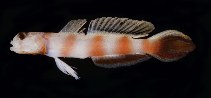
колючие лучи спинного плавника (общее число) : 7; членистые (мягкие) лучи спинного плавника (общее число) : 13 - 3; колючие лучи анального плавника: 1 - 11; членистые (мягкие) лучи анального плавника: 13; позвонки: 25. Diagnosis: Dorsal rays VI-I, 13; anal rays 1, 13; pectoral rays 19; pelvic fins joined by a short membrane at base, with no frenum; fifth pelvic ray branched three times. Longitudinal scale series 89; no median predorsal scales and no prepectoral scales. Gill opening extending forward to below posterior margin of preopercle. Body depth 5.35 in SL; head length 3.55 in SL; mouth not very large, the maxilla reaching to below centre of eye, the upper-jaw length 2.65 in HL; caudal fin slightly pointed and moderately long, 2.9 in SL: fourth pelvic ray longest. Pale yellow dorsally, shading to white ventrally, densely marked with small pale blue spots; four red bars on body, the first slightly oblique beneath first dorsal fin, the next two broader ventrally, below second dorsal fin, and the fourth posteriorly on caudal peduncle and on caudal fin base; head brownish yellow dorsally, white ventrally, with numerous small pale blue spots and a red bar from nape across posterior opercle; an irregular yellow-edged blue line extending ventrally from opercular membrane to branchiostegal membranes; first dorsal fin grey, shading to greyish blue posteriorly, with dark-edged yellow markings; second dorsal fin grey with a dark-edged yellow line parallel to rays on each membrane, the base yellow with dark-edged blue markings; anal fin yellow with irregular dark-edged blue markings and a broad median blackish red band; caudal fin with a large, irregular, elliptical, blue-edged mark enclosing a dusky orange area; upper and lower edges of fin pale yellow with blue spots (Ref. 57552).
Body shape (shape guide): elongated.
Found over coarse sand and lives symbiotically in a burrow with an alpheid shrimp (Ref. 57552). Minimum depth from Ref. 58018.
Life cycle and mating behavior
половая зрелость | размножение | нерест | икра | Fecundity | личинки
Randall, J.E., 2004. Five new shrimp gobies of the genus Amblyeleotris from islands of Oceania. aqua, J. Ichthyol. Aquat. Biol. 8(2):61-78. (Ref. 57552)
Статус Красного Списка МСОП (Ref. 130435: Version 2025-1)
Угроза для людей
Harmless
Использование человеком
дополнительная информация
инструменты
Специальные отчеты
Скачать в формате XML
ресурсы в Интернет
Estimates based on models
Phylogenetic diversity index (ссылка
82804): PD
50 = 0.5000 [Uniqueness, from 0.5 = low to 2.0 = high].
Bayesian length-weight: a=0.00724 (0.00339 - 0.01546), b=3.10 (2.92 - 3.28), in cm total length, based on LWR estimates for this (Sub)family-body shape (Ref.
93245).
Trophic level (ссылка
69278): 3.2 ±0.3 se; based on size and trophs of closest relatives
устойчивость к внешним воздействиям (ссылка
120179): высокий, минимальное время удвоения популяции до 15 месяцев (Preliminary K or Fecundity.).
Fishing Vulnerability (Ref.
59153): Low vulnerability (10 of 100).
🛈