Classificação / Nomes
Nomes comuns | Sinônimos | Catalog of Fishes(Gênero, Espécies) | ITIS | CoL | WoRMS | Cloffa
>
Pleuronectiformes (Flatfishes) >
Soleidae (Soles)
Etymology: Aseraggodes: Greek, aggos, -eos, -ous = vessel, uterus, carapace of a crab + Greek, aseros, -a, -on = to remove the appetite (Ref. 45335); cyclurus: Name from the Greek word 'cyclurus' , referring to the nearly circular caudal fin.
More on author: Randall.
Environment: milieu / Zona climática / intervalo de profundidade / distribution range
Ecologia
marinhas demersal; intervalo de profundidade 15 - 28 m (Ref. 57560). Tropical
Eastern Central Pacific: Tahiti. Western Central Pacific: Fiji to French Polynesia.
Tamanho / Peso / Idade
Maturidade: Lm ? range ? - ? cm
Max length : 7.3 cm SL macho/indeterminado; (Ref. 57560)
Descrição suscinta
Chaves de identificação | Morfologia | Morfometria
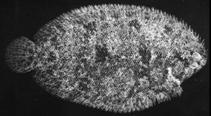
Raios dorsais (total) : 68 - 71; Raios anais : 53. Diagnosis: Dorsal rays 68-71; anal rays 53; most dorsal and anal rays double branched. Lateral-line scales 70-73 (including 6-7 anterior to a vertical at upper end of gill opening). Vertebrae 36-37; dorsal pterygiophores anterior to fourth neural spine 10-11. Body depth 2.25-2.4 in SL; head length (HL) 4.65 (4.7-4.95) in SL. Eye diameter 4.65-4.9 in HL; upper eye overlapping about anterior half of lower eye; interorbital space narrow, the vertical distance separating eyes about three-fourths eye diameter. Caudal peduncle absent. No prominent cirri on ventral edge of head. Lateral line aligned with ventral edge of upper eye. Longest dorsal ray 1.45-1.6 in HL; caudal fin rounded, its length 4.7-4.8 in SL; pelvic fins 2.2-2.4 in HL, the tip of longest ray reaching base of third anal ray. Body on ocular side mottled brown, the scale edges dark brown to black; large irregular blackish blotches, the most prominent comprising 4 below base of dorsal fin, 3 on lateral line, and 2 above posterior half of anal fin (Ref. 57560).
Body shape (shape guide): short and / or deep.
Collected from sand at the entrance to a cave and on a steep rubble and sand slope (Ref. 57560).
Ciclo de vida ou comportamento de acasalamento
Maturidade | Reprodução | Desova | Ovos | Fecundidade | Larvas
Randall, J.E., 2005. A review of soles of the genus Aseraggodes from the South Pacific, with descriptions of seven new species and a diagnosis of Synclidopus. Memoirs of Museum Victoria 62(2):191-212. (Ref. 57560)
Status na Lista Vermelha da UICN (Ref. 130435: Version 2025-1)
Ameaça para os humanos
Harmless
Uso pelos humanos
Ferramentas
Relatórios especiais
Baixar XML
Fontes da internet
Estimates based on models
Preferred temperature (Ref.
123201): 27.1 - 28.4, mean 27.6 °C (based on 12 cells).
Índice de diversidade filogenética (Ref.
82804): PD
50 = 0.5000 [Uniqueness, from 0.5 = low to 2.0 = high].
Bayesian length-weight: a=0.00977 (0.00466 - 0.02049), b=3.07 (2.90 - 3.24), in cm total length, based on LWR estimates for this (Sub)family-body shape (Ref.
93245).
Nível Trófico (Ref.
69278): 3.5 ±0.5 se; based on size and trophs of closest relatives
Resiliência (Ref.
120179): Elevada, tempo mínimo de duplicação da população menor que 15 meses (Preliminary K or Fecundity.).
Fishing Vulnerability (Ref.
59153): Low vulnerability (10 of 100).
🛈