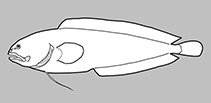
>
Ophidiiformes (Cusk eels) >
Dinematichthyidae (Viviparous brotula)
Etymology: Ogilbia: Taken from Ogilby, 1887-1915, icthiologist and zoologist (Ref. 45335); sedorae: Named for Dr. Allegra Noelle Sedor.
Eponymy: James Douglas Ogilby (1853–1925) was an Irish-born Australian ichthyologist and taxonomist, son of the famous zoologist William Ogilby (below). [...] Dr Allegra Noelle Sedor is a biologist whose master’s degree (1985) and doctorate (1988) were awarded by the University of Southern California. (Ref. 128868), visit book page.
More on authors: Møller, Schwarzhans & Nielsen.
Environment: milieu / climate zone / djupintervall / distribution range
Ekologi
marina revassocierade; djupintervall 0 - 15 m (Ref. 57883). Tropical; 23°N - 6°N (Ref. 57883)
Eastern Pacific: off Colombia to the Gulf of Panama in the south; off Mazatlan, southern Sinaloa province, Mexico, in the north. So far not recorded from the region in between.
Size / Vikt / Age
Könsmognad: Lm ? range ? - ? cm
Max length : 5.9 cm SL hane/ej könsbestämd; (Ref. 57883)
Short description
Bestämningsnycklar | Morfologi | Morfometri
Mjukstrålar i ryggfenan (totalt) : 63 - 73; Mjukstrålar i analfenan: 47 - 54; Ryggkotor: 38 - 41. The species is distinguished by the following: Vertebrae 11-12 + 27-30 = 38-41, dorsal fin rays 63-73, anal fin rays 47-54, outer pseudoclasper very slender, long, wing-shaped, slightly expanded posterodistally, and with single, almost straight supporter; inner pseudoclasper long, stalked, distally with three branches, anterior branch curved, median branch stout, posterior branch fleshy ear-lobed flap; penis tapering; opercular spine with single, sharp tip in
small specimens and furcated (2-3 tips) in specimens greater than 45 mm SL; scale patch on cheeks with 7-8 vertical scale rows; otolith length: height ratio 2.4-2.5 (Ref. 57883).
Inhabits coral and rocky reefs. A 5.9 cm SL female (USNM 263738) contains about 60 eggs, 0.4-0.6 mm in diameter and 140 embryos, 4-5 mm TL, with 2 rows of 2-3 large spots along anal and dorsal fin bases (Ref. 57883).
Life cycle and mating behavior
Könsmognad | Reproduktion | Lek | Ägg | Fecundity | Larver
Møller, P.R., W. Schwarzhans and J.G. Nielsen, 2005. Review of the American Dinematichthyini (Teleostei: Bythitidae). Part II. Ogilbia. aqua, J. Ichthyol. Aquat. Biol. 10(4):133-207. (Ref. 57883)
IUCN Red List Status (Ref. 130435: Version 2025-1)
Threat to humans
Harmless
Human uses
Verktyg
Special reports
Download XML
Internet-källor
Estimates based on models
Preferred temperature (Ref.
123201): 26.8 - 29.1, mean 28.3 °C (based on 99 cells).
Phylogenetic diversity index (Ref.
82804): PD
50 = 0.5000 [Uniqueness, from 0.5 = low to 2.0 = high].
Bayesian length-weight: a=0.00389 (0.00180 - 0.00842), b=3.12 (2.94 - 3.30), in cm total length, based on all LWR estimates for this body shape (Ref.
93245).
Trofisk nivå (Ref.
69278): 3.3 ±0.5 se; based on size and trophs of closest relatives
Fishing Vulnerability (Ref.
59153): Low vulnerability (10 of 100).
🛈