>
Cypriniformes (Carps) >
Cobitidae (Spined loaches)
Etymology: signicauda: Derived from the Latin signum (mark) and cauda (tail), in reference to the conspicuous color pattern on the caudal fin base and caudal fin of this species.
Environment: milieu / climate zone / kisaran kedalaman / distribution range
Ekologi
; air tawar dasar (demersal); pH range: 8.6 - ?. Tropical; 27°C - ? (Ref. 57993)
Asia: Ayeyarwaddy drainage in northern Myanmar.
Size / Weight / umur
Kematangan: Lm ? range ? - ? cm
Max length : 4.2 cm SL jantan/; (Ref. 57993)
deskripsi pendek
Kunci identifiaksi (pengenalan) | Morfologi | Morfometrik
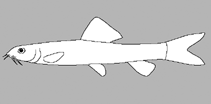
duri punggung lunak (Keseluruhan (total)) : 10; Sirip dubur lunak: 9; vertebrata, bertulang belakang: 54 - 56. Differs from all other Pangia except P. lumbriciformis by its unique color pattern consisting of a number of dark saddle-like marks on the dorsum, a dark transverse stripe or double spot at the caudal fin base and a horizontal stripe and a transverse subdistal band in the caudal fin, and by its total number of 54-56 vertebrae. Can be differentiated from P. lumbriciformis by a more robust body (body depth 10.8-13.8 times in SL vs. 13.6-15.4 times in SL, ratio body depth-body width 1.6-2.2 vs. 1.2-1.5) and a deeper and laterally more compressed caudal peduncle (ratio caudal peduncle depth/width 1.5-2.0 vs. 1.1-1.3). Among other Myanmar Pangia, it is distinguished further from P. fusca and P. pangia by a narrower (caudal peduncle depth 4.1-5.5 % SL vs. 5.9-9.7) and longer caudal peduncle (caudal peduncle length 14.4-16.0 % SL vs. 9.5-12.5), from P. pangia
by a more slender body (body depth 7.2-9.3 % SL vs. 13.5-16.3) and shorter pectoral fins (4.9-6.3 % SL vs. 8.2-9.6), from P. fusca by the presence of the pelvic girdle and fins (vs. absence) and the absence of a nasal barbel (vs. presence), and from P. elongata
by the position of the pelvic fins (basipterygia at vertebra 29 vs. 33) (Ref. 57993).
Body shape (shape guide): elongated.
Facultative air-breathing in the genus (Ref. 126274); Found in stream with slow current, muddy gravel bottom with clear water but dark brown and with lots of algae and aquatic vegetation (Ref. 57993).
Life cycle and mating behavior
Kematangan | Reproduksi, perkembang biakan | Pemijahan | telur-telur | Fecundity | Larva
Britz, R. and J. Maclaine, 2007. A review of the eel-loaches, genus Pangio, from Myanmar (Teleostei: Cypriniformes: Cobitidae). Ichthyol. Explor. Freshwat. 18(1):17-30. (Ref. 57993)
Status IUCN Red List (Ref. 130435: Version 2025-1)
ancaman kepada manusia
Harmless
penggunaan manusia
Perikanan: tidak ada kepentingan
Alat, peralatan
laporan khas
muat turun XML
Sumber internet
Estimates based on models
Phylogenetic diversity index (Acuan
82804): PD
50 = 0.5000 [Uniqueness, from 0.5 = low to 2.0 = high].
Bayesian length-weight: a=0.00501 (0.00233 - 0.01079), b=3.08 (2.90 - 3.26), in cm total length, based on LWR estimates for this (Sub)family-body shape (Ref.
93245).
Trophic level (Acuan
69278): 3.3 ±0.4 se; based on size and trophs of closest relatives
Daya lenting (Acuan
120179): Tinggi, Waktu penggandaan populasi minimum kurang dari 15 bulan (Preliminary K or Fecundity.).
Fishing Vulnerability (Ref.
59153): Low vulnerability (10 of 100).
🛈