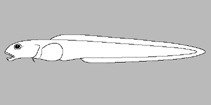
Ericandersonia sagamia

You can sponsor this page

Ericandersonia sagamia Shinohara & Sakurai, 2006

Uploaden van uw Foto's en video's
Google afbeelding
Image of Ericandersonia sagamia
No image available for this species;
drawing shows typical species in Zoarcidae.

Classificatie / Namen Lokale namen | Synoniemen | Catalog of Fishes(Genus, Soort(en)) | ITIS | CoL | WoRMS | Cloffa

> Perciformes/Zoarcoidei (Eelpouts and pricklebacks) > Zoarcidae (Eelpouts) > Gymnelinae
Etymology: Ericandersonia: Named for M. Eric Andersonsagamia: Named after its type locality, Sagami Bay.
Eponymy: Dr Michael Eric Anderson is an American ichthyologist. [...] (Ref. 128868), visit book page.

Environment: milieu / Klimaatzone / Diepte / distribution range Ecologie

marien bathypelagisch; diepte 880 - 930 m (Ref. 58274). Deep-water

Verspreiding Landen | FAO regio's | Ecosystemen | Voorkomen | Verspreidingskaart | Introducties | Faunafri

Northwest Pacific: Sagami Bay, Japan.

Grootte / Gewicht / Leeftijd

Maturiteit: Lm ?  range ? - ? cm
Max length : 21.2 cm SL mannelijk / geslacht onbekend; (Ref. 58274); 21.4 cm SL (female)

Korte beschrijving Determinatiesleutels | Morfologie | Morfometrie

Dorsale zachte stralen (totaal) : 113 - 116; Anale zachte stralen: 93 - 95; Wervels: 117 - 118. Distinguished by the following characters: pseudosubmental crest present; dorsoanterior portion of frontals fused; pareitals meeting in midline; no pelvic fins; ventral ramus of posttemporal weak; postorbital head pores 5; pectoral fin rays 14 (Ref. 58274).
Body shape (shape guide): eel-like; Cross section: oval.

Biologie     Verklarende woordenlijst (bv. epibenthic)

Levenscyclus en paargedrag Maturiteit | Voortplanting | Paaien | Eieren | Fecunditeit | Larven

Hoofdreferentie Upload uw referenties | Referenties | Coördinator | Medewerkers

Shinohara, G. and H. Sakurai, 2006. Ericandersonia sagamia, a new genus and species of deep-water eelpouts (Perciformes: Zoarcidae) from Japan. Ichthyol. Res. 53(2):172-178. (Ref. 58274)

Status op de Rode Lijst van het IUCN (Ref. 130435: Version 2025-1)


CITES

Not Evaluated

CMS (Ref. 116361)

Not Evaluated

Gevaar voor de mens

  Harmless


Gebruik door de mens

FAO - Publication: search | FishSource |

Meer informatie

Trofische ecologie
Food items (preys)
Dieetsamenstelling
Voedselconsumptie
Food rations
Predatoren
Ecologie
Ecologie
Home ranges
Population dynamics
Groeiparameters
Max. ages / sizes
Length-weight rel.
Length-length rel.
Lengtefrequenties
Massaconversie
Rekrutering
Abundantie
Life cycle
Voortplanting
Maturiteit
Maturity/Gills rel.
Fecunditeit
Paaien
Spawning aggregations
Eieren
Ontwikkeling van de eieren
Larven
Larvale populatiedynamiek
Verspreiding
Landen
FAO regio's
Ecosystemen
Voorkomen
Introducties
BRUVS - Videos
Anatomy
Kieuwoppervlak
Brain
Otolith
Physiology
Body composition
Nutrients
Zuurstofverbruik
Zwemtype
Zwemsnelheid
Visual pigments
Fish sound
Diseases & Parasites
Toxicity (LC50s)
Genetica
genoom
Genetica
Heterozygosity
Erfelijkheid
Human related
Aquaculture systems
Aquacultuurprofielen
Kweeklijnen
Ciguatera cases
Stamps, coins, misc.
Outreach
Medewerkers
Referenties
Referenties

Tools

Speciale rapporten

Download XML

Internetbronnen

AFORO (otoliths) | Aquatic Commons | BHL | Cloffa | Websites from users | Bekijk FishWatcher | CISTI | Catalog of Fishes: Genus, Soort(en) | DiscoverLife | ECOTOX | FAO - Publication: search | Faunafri | Fishipedia | Fishtrace | GloBI | Google Books | Google Scholar | Google | IGFA World Record | OneZoom | Open Tree of Life | Otolith Atlas of Taiwan Fishes | PubMed | Reef Life Survey | Socotra Atlas | TreeBase | Tree of Life | Wikipedia: ga naar, zoek | Zoobank | Zoological Record

Estimates based on models

Fylogenetische diversiteitsindex (Ref. 82804):  PD50 = 1.0000   [Uniqueness, from 0.5 = low to 2.0 = high].
Bayesian length-weight: a=0.00110 (0.00042 - 0.00288), b=3.09 (2.86 - 3.32), in cm total length, based on LWR estimates for this (Sub)family-body shape (Ref. 93245).
Trofisch niveau (Ref. 69278):  3.2   ±0.4 se; based on size and trophs of closest relatives
Weerstandsvermogen (Ref. 120179):  Gemiddeld, minimale populatieverdubbelingstijd 1,4-4,4 jaar (Preliminary K or Fecundity.).
Fishing Vulnerability (Ref. 59153):  Low vulnerability (16 of 100). 🛈