Klassifizierung / Names
Namen | Synonyme | Catalog of Fishes(Gattung, Arten) | ITIS | CoL | WoRMS | Cloffa
>
Ovalentaria/misc (Various families in series Ovalentaria) >
Pomacentridae (Damselfishes) > Chrominae
Etymology: Chromis: Greek, chromis = a fish, perhaps a perch (Ref. 45335); abyssus: Name from Latin form of the Greek noun 'abyssos' meaning abyss, for the documentary film Pacific Abyss, produced by the British Broadcasting Corporation (BBC), which funded the expedition on which the type specimens were collected.
Eponymy: Not a true eponym but named for the documentary film Pacific Abyss, produced by the British Broadcasting Corporation (BBC), which funded the expedition during which the holotype was collected. (Ref. 128868), visit book page.
Environment: milieu / climate zone / Tiefenbereich / distribution range
Ökologie
seewasser riff-verbunden; tiefenbereich 107 - 150 m (Ref. 90102). Tropical
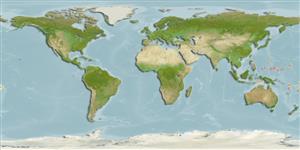
Western Pacific: Palau.
Size / Gewicht / Alter
Geschlechtsreife: Lm ? range ? - ? cm
Max length : 9.8 cm SL Männchen/unbestimmt; (Ref. 59379)
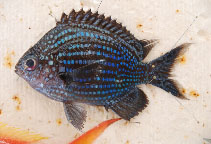
Rückenflossenstacheln (insgesamt) : 14; Rückenflossenweichstrahlen (insgesamt) : 12 - 13; Afterflossenstacheln: 2; Afterflossenweichstrahlen: 12 - 14. This species is distinguished by the following characters: Dorsal rays XIV,12-13, usually 13; anal rays II,12-14, usually 13; pectoral rays 18-19, usually 19; spiniform caudal rays 3; tubed lateral-line scales 14-16; gill rakers 6-7 + 17-18, usually 7 + 18, total 24-25, usually 25; body depth 1.58-1.83 in SL; the color when fresh is dark gray with a large iridescent dark blue spot at center of each scale; membranes on median fins and pelvic fins opaque charcoal gray, with an iridescent dark blue margin on the spinous part of the dorsal and anal fins; caudal fin mottled iridescent dark blue and black; pectoral fins with a black ovoid spot covering the basal portion and pectoral-fin axis (Ref. 59379).
Body shape (shape guide): short and / or deep; Cross section: compressed.
Adults appear to prefer depths more that 115 m, staying close to the substratum, sand and rubble slope with boulders and rock outcroppings. They take refuge in small caves and holes. Juveniles and some subadults were observed around limestone talus. Adults were usually solitary or in pairs, while subadults and juveniles were seen in small groups. Oviparous, distinct pairing during breeding (Ref. 205). Eggs are demersal and adhere to the substrate (Ref. 205). Males guard and aerate the eggs (Ref. 205). Other Chromis associated with this species include C. brevirostris, C. degruyi and C. earina (Ref. 59379).
Life cycle and mating behavior
Geschlechtsreife | Fortpflanzung | Ablaichen | Eier | Fecundity | Larven
Oviparous, distinct pairing during breeding (Ref. 205). Eggs are demersal and adhere to the substrate (Ref. 205). Males guard and aerate the eggs (Ref. 205).
Pyle, R., J.L. Earle and B.D. Greene, 2008. Five new species of the damselfish genus Chromis (Perciformes: Labroidei: Pomacentridae) from deep coral reefs in the tropical western Pacific. Zootaxa 1671:3-31. (Ref. 59379)
IUCN Rote Liste Status (Ref. 130435: Version 2025-1)
Bedrohung für Menschen
Harmless
Nutzung durch Menschen
Tools
Zusatzinformationen
Download XML
Internet Quellen
Estimates based on models
Preferred temperature (Ref.
123201): 9 - 26.8, mean 15.9 °C (based on 47 cells).
Phylogenetic diversity index (Ref.
82804): PD
50 = 0.5000 [Uniqueness, from 0.5 = low to 2.0 = high].
Bayesian length-weight: a=0.01820 (0.00804 - 0.04119), b=2.99 (2.81 - 3.17), in cm total length, based on LWR estimates for this Genus-body shape (Ref.
93245).
Trophic level (Ref.
69278): 3.0 ±0.1 se; based on size and trophs of closest relatives
Widerstandsfähigkeit (Ref.
120179): hoch, Verdopplung der Population dauert weniger als 15 Monate. (Preliminary K or Fecundity.).
Fishing Vulnerability (Ref.
59153): Low vulnerability (10 of 100).
🛈