Classification / Names
Noms communs | Synonymes | Catalog of Fishes(Genre, Espèce) | ITIS | CoL | WoRMS | Cloffa
>
Ovalentaria/misc (Various families in series Ovalentaria) >
Pomacentridae (Damselfishes) > Chrominae
Etymology: Azurina: Latin, azurinus = blue, pale blue; the name of Leuciscus caeruleus, blue Roach; 1600 (Ref. 45335); brevirostris: Name from Latin words 'brevis' meaning short and 'rostrum' for beak or snout, referring to the very short snout of this species relative to other species in the genus.
Environment: milieu / climate zone / profondeur / distribution range
Écologie
marin récifal; profondeur 42 - 120 m (Ref. 59379), usually 90 - 120 m (Ref. 90102). Tropical; 12°N - 21°S, 134°E - 178°W
Western Pacific: Marshall Islands southward to Fiji, across the Caroline Islands from Puluwat to Palau, and south to Vanuatu. This species was not observed at Rarotonga (Cook Islands), Kiritimati (Line Islands), nor in American Samoa during brief surveys of deep reefs in these areas.
Taille / Poids / Âge
Maturité: Lm ? range ? - ? cm
Max length : 6.9 cm SL mâle / non sexé; (Ref. 59379)
Description synthétique
Clés d'identification | Morphologie | Morphométrie
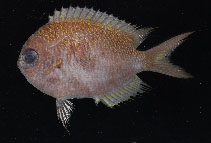
Épines dorsales (Total) : 13; Rayons mous dorsaux (Total) : 13 - 14; Épines anales: 2; Rayons mous anaux: 15 - 16. This species is distinguished by the following characters: Dorsal rays XIII,13-14, usually 14; anal rays II,15-16; pectoral rays 18-19, usually 19; spiniform caudal rays 2-3, usually 3; tubed lateral-line scales 14-16; gill rakers 6-8 + 19-22 (usually 6-7 + 19-21; total 26-29); body depth 1.57-1.77 in SL. Color when fresh is pale lavender-tinged gray dorsally, paler ventrally; 3 or 4 rows of scales dorsally from nape to upper caudal peduncle with gold edges; small scales on basal sheath of dorsal fin almost entirely gold; median fin membranes lavender gray or translucent blue, suffused with gold color; iris yellow (Ref. 59379).
Body shape (shape guide): short and / or deep.
Adults are generally abundant in their usual environment, steep slopes and drop-offs at depths of about 90-120 m; usually with small holes and limestone talus, often in aggregations ranging from 6 to several dozen individuals seen feeding low in the water column (Ref. 59379). Oviparous, distinct pairing during breeding (Ref. 205). Eggs are demersal and adhere to the substrate (Ref. 205). Males guard and aerate the eggs (Ref. 205). Minimum range from Ref. 82433, where this species was found together with Chromis unipa.
Life cycle and mating behavior
Maturité | Reproduction | Frai | Œufs | Fécondité | Larves
Oviparous, distinct pairing during breeding (Ref. 205). Eggs are demersal and adhere to the substrate (Ref. 205). Males guard and aerate the eggs (Ref. 205).
Pyle, R., J.L. Earle and B.D. Greene, 2008. Five new species of the damselfish genus Chromis (Perciformes: Labroidei: Pomacentridae) from deep coral reefs in the tropical western Pacific. Zootaxa 1671:3-31. (Ref. 59379)
Statut dans la liste rouge de l'IUCN (Ref. 130435: Version 2025-1)
Menace pour l'homme
Harmless
Utilisations par l'homme
Outils
Articles particuliers
Télécharger en XML
Sources Internet
Estimates based on models
Preferred temperature (Réf.
123201): 24.4 - 26.6, mean 26.4 °C (based on 18 cells).
Phylogenetic diversity index (Réf.
82804): PD
50 = 0.5010 [Uniqueness, from 0.5 = low to 2.0 = high].
Bayesian length-weight: a=0.02089 (0.00944 - 0.04623), b=2.98 (2.80 - 3.16), in cm total length, based on LWR estimates for this (Sub)family-body shape (Ref.
93245).
Niveau trophique (Réf.
69278): 3.3 ±0.4 se; based on size and trophs of closest relatives
Résilience (Réf.
120179): Haut, temps minimum de doublement de population inférieur à 15 mois (Preliminary K or Fecundity.).
Fishing Vulnerability (Ref.
59153): Low vulnerability (10 of 100).
🛈