



Trichomycterus therma Fernández & Miranda, 2007
Carica il tuo foto e Video
Google image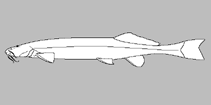 No image available for this species;
drawing shows typical species in Trichomycteridae.
Google image
drawing shows typical species in Trichomycteridae.
Classificazione / Nomi Nomi Comuni | Sinonimi | Catalog of Fishes(Genere, Specie) | ITIS | CoL | WoRMS | Cloffa
> Siluriformes (Catfishes) > Trichomycteridae (Pencil or parasitic catfishes) > Trichomycterinae
Etymology: Trichomycterus: Greek, thrix = hair + Greek, mykter, -eros = nose (Ref. 45335); therma: Specific name, therma (hot), from the Greek city of Therma, known for its hot springs, referring to the habitat of this species in thermal water.
Etymology: Trichomycterus: Greek, thrix = hair + Greek, mykter, -eros = nose (Ref. 45335); therma: Specific name, therma (hot), from the Greek city of Therma, known for its hot springs, referring to the habitat of this species in thermal water.
Ambiente: milieu / zona climatica / distribuzione batimetrica / gamma di distribuzione Ecologia
; acqua dolce demersale; pH range: 8.2 - ?; distribuzione batimetrica 0 - ? m (Ref. 72406). Tropical; 37°C - ? (Ref. 72406)
Distribuzione Territories | Aree FAO | Ecosistemi | Presenze | Mappa dei ritrovamenti | Introduzioni | Faunafri
South America: thermal stream in Miraflores, north of Potosi, Bolivia.
Dimensione / Peso / Età
Breve descrizione Chiavi di identificazione | Morfologia | Morfometria
Raggi dorsali molli (totale) : 14; Raggi anali molli: 11; Vertebre: 32. Can be easily distinguished from all other species of the genus Trichomycterus from western and southern South America by possessing an autapomorphic thickened transverse skin on the ventral surface of the head. Differs further from other congeners except Trichomycterus corduvensis from Argentina and Trichomycterus tiraquae from Bolivia by the combination of the following characters: presence of spatulate incisiform premaxillary teeth; presence of large and rounded papilla-like structures on the trunk of the body; the continuous segment of the laterosensory canal within the frontal with the presence of a segment between pores 2 and 6; and laterosensory canal on trunk with 4 to 6 pores. Can be differentiated from Trichomycterus tiraquae and Trichomycterus corduvensis by the shape of the maxilla, which has a short anterior process that is shorter than the main axis of the bone and is anteriorly oriented (vs. anterior process enlarged and equal to, or longer than
the main axis of the bone and with an anterolateral orientation); mesethmoid shaft narrower than the width of the lateral cornua (vs. shaft equal to or wider than width of lateral cornua). Differ also from Trichomycterus tiraquae by having prepelvic length 58.7-61.0% of SL (vs. 56.6-57.6), head width 19.1-22.8% of SL (vs. 17.4-18.9); the submaxillary barbel length 23.9-37.5% of SL (vs. 43.3-54.8) (Ref. 72406).
Body shape (shape guide): elongated.
Body shape (shape guide): elongated.
Inhabits clear water stream with depth 0.15-0.5 m and that runs over clay and rock-pebble substrata with algae and with high geothermal activity. Found mainly in the area with water temperature of 37°C and pH of 8.2 (Ref. 72406). Stomach contents based on three specimens showed that Diptera (mostly Chironomidae) and Coleoptera (Elmidae) as the main components of the diet of this species (Ref. 72406).
Ciclo vitale e comportamento di accoppiamento Maturità | Riproduzione | Deposizione | Uova | Fecondità | Larve
Riferimento principale
Caricare le referenze | Bibliografia | Coordinatore : Pinna, Mário de | Collaboratori
Fernández, L. and G. Miranda, 2007. A catfish of the genus Trichomycterus from a thermal stream in southern South America (Teleostei, Siluriformes, Trichomycteridae), with comments on relationships within the genus. J. Fish Biol. 71(5):1303-1316. (Ref. 72406)
Stato della Lista Rossa IUCN (Ref. 130435: Version 2025-2 (Global))
Critically Endangered (CR) (B2ab(iii)); Date assessed: 27 October 2020
CITES
Not Evaluated
Minaccia per l'uomo
Harmless
Usi umani
FAO - Publication: search | FishSource |
Informazioni ulteriori
Ecologia trofica
Articoli alimentari (prede)
Alimentazione
Consumo di cibo
Razioni alimentari
Predatori
Articoli alimentari (prede)
Alimentazione
Consumo di cibo
Razioni alimentari
Predatori
Ecologia
Ecologia
Ecologia
Dinamica della popolazione
Parametri di crescita
Età massima / dimensioni massime
Rapporto lunghezza-peso.
Lunghezza-lunghezza rel.
Lunghezza-frequenze
Conversione di massa
Reclutamento
Abbondanza
Parametri di crescita
Età massima / dimensioni massime
Rapporto lunghezza-peso.
Lunghezza-lunghezza rel.
Lunghezza-frequenze
Conversione di massa
Reclutamento
Abbondanza
Ciclo di vita
Riproduzione
Maturità
Maturità/Gli occhielli sono relativi.
Fecondità
Deposizione
Aggregazioni riproduttive
Uova
Sviluppo delle uova
Larve
Dinamica popolazioni larvali
Riproduzione
Maturità
Maturità/Gli occhielli sono relativi.
Fecondità
Deposizione
Aggregazioni riproduttive
Uova
Sviluppo delle uova
Larve
Dinamica popolazioni larvali
Anatomia
Area branchiale
Cervello
Otolite
Area branchiale
Cervello
Otolite
Fisiologia
Composizione corporea
Nutrienti
Consumo di ossigeno
Tipo di nuoto
Velocità di nuoto
Pigmenti visivi
Suono del pesce
Malattie e parassiti
Tossicità (LC50)
Composizione corporea
Nutrienti
Consumo di ossigeno
Tipo di nuoto
Velocità di nuoto
Pigmenti visivi
Suono del pesce
Malattie e parassiti
Tossicità (LC50)
Genetica
Genome
Genetica
Eterozigosi
Ereditarietà
Diversità genetica
Genome
Genetica
Eterozigosi
Ereditarietà
Diversità genetica
Legato all'uomo
Sistemi di acquacoltura
Profili di acquacoltura
Varietà
Casi di Ciguatera
Francobolli, monete, materiale vario.
Sistemi di acquacoltura
Profili di acquacoltura
Varietà
Casi di Ciguatera
Francobolli, monete, materiale vario.
Strumenti
Libro elettronico | Giuda pratica | Generatore frequenze di lunghezza | Strumento Parametri Biologici | Mappa dei ritrovamenti |
Cattura-MSY |
Rapporti speciali
Controllo della manutenzione dell'acquario | Verificare la presenza di schede informative sulle specie | Verifica delle schede informative sull'acquacoltura
Scarica XML
Fonti Internet
AFORO (otoliths) | Aquatic Commons | BHL | Cloffa | Websites from users | Check FishWatcher | CISTI | Catalog of Fishes: Genere, Specie | DiscoverLife | ECOTOX | FAO - Publication: search | Faunafri | Fishipedia | Fishtrace | GloBI | Google Books | Google Scholar | Google | IGFA World Record | OneZoom | Open Tree of Life | Otolith Atlas of Taiwan Fishes | PubMed | Reef Life Survey | Socotra Atlas | TreeBase | Tree of Life | Wikipedia: Go, ricerca | World Records Freshwater Fishing | Zoobank | Record zoologico
Stime basate su modelli
Indice di diversità filogenetica (Fonte Biblio. 82804): PD50 = 0.5000 [Uniqueness, from 0.5 = low to 2.0 = high].
Bayesian length-weight: a=0.00912 (0.00396 - 0.02102), b=2.97 (2.79 - 3.15), in cm total length, based on LWR estimates for this Genus-body shape (Ref. 93245).
Livello trofico (Fonte Biblio. 69278): 3.2 ±0.4 se; based on size and trophs of closest relatives