



Dichichthys albimarginatus (Séret & Last, 2007)
Whitetip bristle shark
Hochladen Photos und videos
Bilder | Google Bild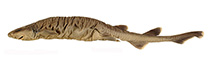 Dichichthys albimarginatus
Male Photo von Séret, B./Last, P.R.
Bilder | Google Bild
Male Photo von Séret, B./Last, P.R.
Klassifizierung / Names Namen | Synonyme | Catalog of Fishes(Gattung, Arten) | ITIS | CoL | WoRMS | Cloffa
Elasmobranchii (Haie und Rochen) (sharks and rays) > Carcharhiniformes (Ground sharks) > Dichichthyidae (Bristle shark)
Etymology: Dichichthys: Name from the combination of the Greek 'dicho'- meaning 'to branch in two' and 'ichthys' for 'fish', with this genus being intermediate between the Galeus-Parmaturus complex and Apristurus; albimarginatus: albus (L.), white; marginatus (L.), bordered, referring to broad white margins on posterior fins (See ETYFish).
More on authors: Séret & Last.
Etymology: Dichichthys: Name from the combination of the Greek 'dicho'- meaning 'to branch in two' and 'ichthys' for 'fish', with this genus being intermediate between the Galeus-Parmaturus complex and Apristurus; albimarginatus: albus (L.), white; marginatus (L.), bordered, referring to broad white margins on posterior fins (See ETYFish).
More on authors: Séret & Last.
Umwelt: Milieu / Klimazone / Tiefenbereich / Verbreitungsgebiet Ökologie
seewasser bathydemersal; tiefenbereich 590 - 732 m (Ref. 74543). Deep-water
Verbreitung Territorien | FAO Gebiete | Ökosysteme | Vorkommen | Punkt Karte | Einführungen | Faunafri
Western Pacific: New Caledonia and possibly Papua New Guinea.
Größe / Gewicht / Alter
Kurzbeschreibung Bestimmungsschlüssel | Morphologie | Morphometrie
This scyliorhinid catshark is characterized by the following: a soft body with velvet-like
skin of large tricuspidate denticles; color plain pale to medium brown; posterior margins of the dorsal, caudal and anal-fins are distinctly white-edged; upper and lower anterior caudal fin margins with pronounced caudal crests, the denticles on crests are greatly enlarged; teeth are mainly tricuspidate with greatly elongate median cusps, in 92 rows in both jaws; the first dorsal fin is slightly behind middle of back, the pelvic fins slightly in front of mid-body, prepelvic
length 47% TL; vent at mid-length, pre-vent length 50% TL; relatively short snout, prenarial length 3.7% TL; short mouth, length 3.7% TL; short labial furrows, 1.7-2.0% TL, lower furrows subequal in length to upper furrows; head depressed and is shorter than abdomen, length 19.2% TL, pectoral-pelvic length 24.8% TL; second dorsal fin is larger than first, anterior margins of first 8.7% and second dorsal fin 10.4% TL; subterminal caudal lobe relatively small, subterminal margin length 3.3% TL, terminal margin length 3.8% TL; 43 monospondylous centra; 95 precaudal centra, 136 total (Ref. 74543).
Body shape (shape guide): elongated.
Body shape (shape guide): elongated.
Lebenszyklus und Paarungsverhalten Geschlechtsreife | Fortpflanzung | Ablaichen | Eier | Fruchtbarkeit | Larven
Hauptreferenz
Laden Sie Ihre Referenzen hoch | Referenzen | Koordinator | Partner
White, W.T., A.L. Stewart, H.L. O’Neill and G.J.P. Naylor, 2024. Dichichthyidae, a new family of deepwater sharks (Carcharhiniformes) from the Indo–West Pacific, with description of a new species. Fishes 2024, 9, 121. (Ref. 130868)
IUCN Rote Liste Status (Ref. 130435: Version 2025-2 (Global))
nicht bedroht (LC) ; Date assessed: 19 June 2017
CITES
Not Evaluated
Bedrohung für Menschen
Harmless
Nutzung durch Menschen
Fischereien: nicht kommerziell
FAO - Publication: search | FishSource |
Mehr Information
Trophische Ökologie
Lebensmittel (Beutetiere)
Nahrungszusammensetzung
Nahrungsaufnahme
Lebensmittelrationen
Räuber
Lebensmittel (Beutetiere)
Nahrungszusammensetzung
Nahrungsaufnahme
Lebensmittelrationen
Räuber
Ökologie
Ökologie
Ökologie
Populationsdynamik
Wachstumsparameter
Max. Alter/Größen
Länge-Gewicht-Rel.
Länge-Länge-Verhältnis.
Längenhäufigkeiten
Massenkonvertierung
Rekrutierung
Dichte
Wachstumsparameter
Max. Alter/Größen
Länge-Gewicht-Rel.
Länge-Länge-Verhältnis.
Längenhäufigkeiten
Massenkonvertierung
Rekrutierung
Dichte
Lebenszyklus
Fortpflanzung
Geschlechtsreife
Reifung/Kiemen rel.
Fruchtbarkeit
Ablaichen
Laichaggregationen
Eier
Eientwicklung
Larven
Larven Pop.Dyn.
Fortpflanzung
Geschlechtsreife
Reifung/Kiemen rel.
Fruchtbarkeit
Ablaichen
Laichaggregationen
Eier
Eientwicklung
Larven
Larven Pop.Dyn.
Anatomie
Kiemenoberfläche
Gehirn
Otolith
Kiemenoberfläche
Gehirn
Otolith
Physiologie
Körperliche Zusammensetzung
Nährstoffe
Sauerstoffverbrauch
Schwimmart
Schwimmgeschwindigkeit
Visuelle Pigmente
Fischgeräusche
Krankheiten und Parasiten
Toxizität (LC50s)
Körperliche Zusammensetzung
Nährstoffe
Sauerstoffverbrauch
Schwimmart
Schwimmgeschwindigkeit
Visuelle Pigmente
Fischgeräusche
Krankheiten und Parasiten
Toxizität (LC50s)
Genetik
Genom
Genetik
Heterozygotie
Vererbbarkeit
Genetische Vielfalt
Genom
Genetik
Heterozygotie
Vererbbarkeit
Genetische Vielfalt
Menschenbezogen
Aquakultur-Systeme
Aquakultur Profile
Zuchtlinien
Ciguatera-Fälle
Briefmarken, Münzen, Verschiedenes.
Aquakultur-Systeme
Aquakultur Profile
Zuchtlinien
Ciguatera-Fälle
Briefmarken, Münzen, Verschiedenes.
Tools
E-Book | Feldführer | Bestimmungsschlüssel | Längenhäufigkeits Tool | Lebensdaten Tool | Punkt Karte |
Catch-MSY |
Zusatzinformationen
Download XML
Zusammenfassung | Punktdaten | Namen | Photos
Internet Quellen
AFORO (otoliths) | Aquatic Commons | BHL | Cloffa | Websites from users | FishWatcher Einträge suchen | CISTI | Catalog of Fishes: Gattung, Arten | DiscoverLife | ECOTOX | FAO - Publication: search | Faunafri | Fishipedia | Fishtrace | GloBI | Google Books | Google Scholar | Google | IGFA World Record | OneZoom | Open Tree of Life | Otolith Atlas of Taiwan Fishes | PubMed | Reef Life Survey | Socotra Atlas | TreeBase | Tree of Life | Wikipedia: Gehe zu, Suchen | World Records Freshwater Fishing | Zoologischer Rekord
Schätzungen auf der Grundlage von Modellen
Phylogenetischer Diversitätsindex (Ref. 82804): PD50 = 0.5625 [Uniqueness, from 0.5 = low to 2.0 = high].
Bayesian length-weight: a=0.00389 (0.00180 - 0.00842), b=3.12 (2.94 - 3.30), in cm total length, based on all LWR estimates for this body shape (Ref. 93245).
Trophische Ebene (Ref. 69278): 3.9 ±0.5 se; based on size and trophs of closest relatives