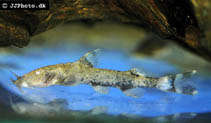
Klassifizierung / Names
Namen | Synonyme | Catalog of Fishes(Gattung, Arten) | ITIS | CoL | WoRMS | Cloffa
>
Siluriformes (Catfishes) >
Sisoridae (Sisorid catfishes) > Sisorinae
Etymology: Glyptothorax: Greek, glyptes = carver + Greek, thorax = breast (Ref. 45335); rugimentum: Derived from the Latin ruga (crease), and mentum (chin), in reference to the presence of unculiferous skin ridges on the gular region.
More on authors: Ng & Kottelat.
Environment: milieu / climate zone / Tiefenbereich / distribution range
Ökologie
; süßwasser demersal. Tropical
Asia: Ataran, Salween and Sittang River drainages in Myanmar and western Thailand.
Size / Gewicht / Alter
Geschlechtsreife: Lm ? range ? - ? cm
Max length : 7.9 cm SL Männchen/unbestimmt; (Ref. 74930)
Kurzbeschreibung
Bestimmungsschlüssel | Morphologie | Morphometrie
Rückenflossenstacheln (insgesamt) : 1; Rückenflossenweichstrahlen (insgesamt) : 6; Afterflossenweichstrahlen: 10 - 11; Wirbelzahl: 35 - 38. Can be differentiated from all members of the Glyptothorax except Glyptothorax indicus in having the unculiferous ridges of the thoracic adhesive apparatus extending anteriorly onto the gular region (vs. gular region without unculiferous ridges). Differs from Glyptothorax indicus in having a wider head (19.1-22.6% SL vs. 16.3-18.9), larger eye (8.4-11.6% HL vs. 6.2-8.1), shorter nasal barbels (not reaching anterior orbital margin vs. reaching to middle of orbit; 24.5-37.1% HL vs. 37.8-52.5), a narrower thoracic adhesive apparatus (in a rhomboidal, somewhat U-shaped field vs. a more laterally divergent chevron-shaped field), pelvic-fin origin at (vs. posterior) vertical through base of last dorsal-fin ray, a more steeply-sloping posterior margin of the adipose fin, and the presence ( vs. absence) of light and dark vertical bands on the caudal peduncle (Ref. 74930).
Body shape (shape guide): elongated.
Life cycle and mating behavior
Geschlechtsreife | Fortpflanzung | Ablaichen | Eier | Fecundity | Larven
Ng, H.H. and M. Kottelat, 2008. Glyptothorax rugimentum, a new species of catfish from Myanmar and western Thailand (Teleostei: Sisoridae). Raffles Bull. Zool. 56(1):129-134. (Ref. 74930)
IUCN Rote Liste Status (Ref. 130435: Version 2025-1)
Bedrohung für Menschen
Harmless
Nutzung durch Menschen
Fischereien: nicht kommerziell
Tools
Zusatzinformationen
Download XML
Internet Quellen
Estimates based on models
Phylogenetic diversity index (Ref.
82804): PD
50 = 0.5000 [Uniqueness, from 0.5 = low to 2.0 = high].
Bayesian length-weight: a=0.00813 (0.00369 - 0.01791), b=3.00 (2.83 - 3.17), in cm total length, based on LWR estimates for this Genus-body shape (Ref.
93245).
Trophic level (Ref.
69278): 3.2 ±0.4 se; based on size and trophs of closest relatives
Fishing Vulnerability (Ref.
59153): Low vulnerability (10 of 100).
🛈